Comparison
Aleatoric vs Epistemic Uncertainty
Understanding the difference between the noise in the data and the ignorance of the model.
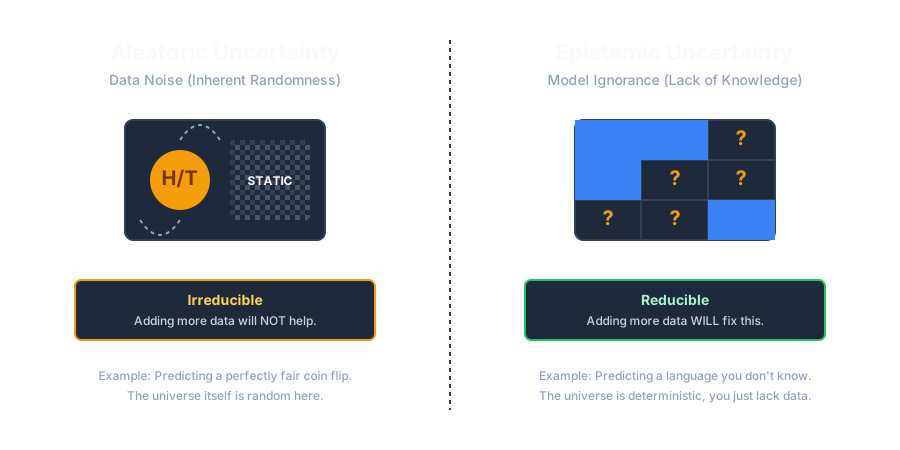
Verdict: Aleatoric uncertainty is inherent randomness you can never fix. Epistemic uncertainty is model ignorance that you can fix by gathering more data.
Quick Version (TL;DR)
Understanding the difference between the noise in the data and the ignorance of the model.
The Short Answer
When a machine learning model is unsure about a prediction, that uncertainty comes from one of two completely different sources.
- Aleatoric Uncertainty (Data Noise): The uncertainty is built into the universe or the measurement tools. It is inherent randomness.
- Epistemic Uncertainty (Model Ignorance): The uncertainty comes from a lack of knowledge. The model simply hasn't seen enough data of this specific type to know the right answer.
Where They Differ
| Feature | Aleatoric (Data) | Epistemic (Model) |
|---|---|---|
| Source | The data generation process (noise, true randomness). | The model (lack of training data). |
| Can it be reduced? | No. (Irreducible). | Yes. (Reducible). |
| How to fix it? | You can't. Just build models that acknowledge the noise. | Collect more data in the regions where the model is uncertain. |
| Example | Predicting a fair coin flip. | Being asked a question in a language you haven't learned yet. |
Why the Distinction Matters (Self-Driving Cars)
Imagine a self-driving car approaching an intersection. It uses a neural network to predict the path of a pedestrian.
Scenario A (Epistemic): The pedestrian is riding a unicycle while juggling. The car's model has never seen this in its training data. Its Epistemic uncertainty spikes to 99%.
- The Fix: If the engineers add 1,000 videos of juggling unicyclists to the training data and retrain, the model will learn exactly what to do. The uncertainty vanishes.
Scenario B (Aleatoric): The car is driving in a torrential blizzard. The cameras are covered in snow, and the LiDAR is reflecting off snowflakes. The model has seen blizzards millions of times, but the sensory data is physically degraded. Its Aleatoric uncertainty spikes.
- The Fix: Adding 10 million more blizzard videos will not help the model see through the snow. The data is inherently corrupted. The only solution is to program the car to pull over safely.
How to Measure Them
Modern deep learning is getting very good at separating these two.
To measure Aleatoric uncertainty, we change the output of the neural network. Instead of outputting a single number (e.g., predicted price: $100), we force it to output a mean and a variance (predicted price: $100, variance: $20). The model learns to predict its own noise.
To measure Epistemic uncertainty, we often use a technique called Monte Carlo Dropout. We leave Dropout turned on during inference and predict the same image 50 times. If the model knows the answer, all 50 predictions will be identical. If the model is ignorant, the 50 predictions will wildly disagree with each other.
What People Get Wrong
Throwing more data at an Aleatoric problem
Data Scientists often see high error rates and immediately demand "more data." Gathering data is expensive. If the error is driven by Epistemic uncertainty, the investment pays off. If the error is driven by Aleatoric uncertainty (e.g., predicting the stock market, which is inherently noisy), spending $1M on more data will yield zero improvement. You must diagnose the uncertainty first.