For students, engineers and interview prep
See how AI and machine learning actually work.
Hand-drawn diagrams show the mechanism. Interactive playgrounds let you change it and watch what happens. Plain-language guides connect the ideas, from gradient descent to transformers, RAG and agents.
- Free to read
- No account needed
- Real maths in every playground
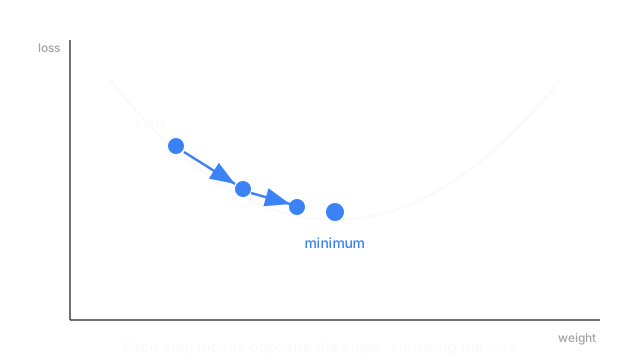
Gradient descent: one start, three step sizes. Too small crawls, too large diverges, and one lands on the minimum.
Change the learning rate yourselfChoose your way in
What do you want to do today?
Pick the one that matches why you came. Every path links into the others, so you can switch at any point.
Understand an idea
Start with why an idea exists, then see how it works, one diagram at a time.
Browse concept guidesWatch it move
Drag the data, change a setting and watch a real model respond.
Open the playgroundsPrepare for an interview
Answers with the reasoning and trade-offs interviewers probe, plus system design and coding patterns.
Practise interview questionsFollow a roadmap
Ordered routes toward roles like ML engineer, data scientist and LLM engineer.
Find a learning path
New here?
Start with how a machine learns
Three steps, one idea: what machine learning is, how a model improves, and a playground where you take the controls.
- See it
What machine learning is
Machine learning fits patterns from data. Follow a toy classifier from labelled examples to a held-out test and see why memorization fails.
Follow the diagrams - Understand it
How a model learns from its mistakes
Work out which way the loss falls, step a little that way, repeat.
Read the guide - Try it
Train a model yourself
Drag the data, drag the line, then watch an optimiser find the fit for you — one real gradient step at a time.
Open the playground
Generative AI
The ideas behind ChatGPT, RAG and AI agents
Each guide opens with the problem an idea solves, then walks through the mechanism with a diagram.
How LLMs Work
Follow text through tokens, vectors and a stack of transformer blocks to a probability for each possible next token.
Read the guideTransformer Architecture
One block, repeated many times: self-attention and a feed-forward network, each wrapped in a residual connection and normalization.
Read the guideSelf-Attention
Each token scores its query against every key in the sequence, and those scores set how much of each value it blends in.
Read the guideEmbeddings
Words and documents become vectors where distance means similarity, so related text sits close even with no shared words.
Read the guideRAG Architecture
Index documents once, match each question against that index, and put the closest passages in the prompt before the model answers.
Read the guideTool Use & Function Calling
The model names a tool and its arguments, and real code checks and runs the call instead of the model guessing.
Read the guide
Visual explainers
See the idea before the equation
Each explainer walks through one mechanism as a numbered sequence of diagrams, with just enough words to connect them.
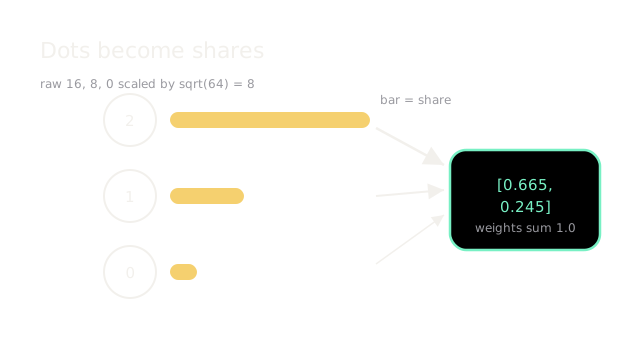
Transformers
Trace positioned token rows through attention heads, residual normalization and a feed-forward network, then inspect decoder masks…
See it step by step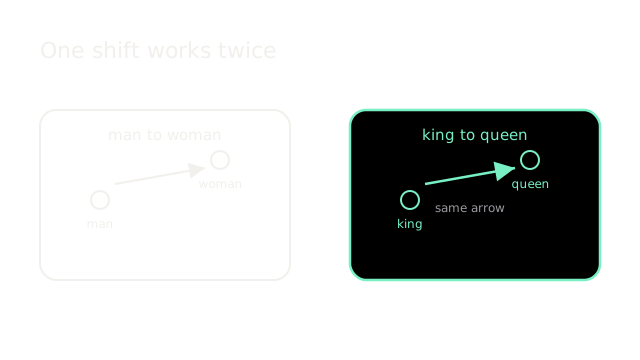
Embedding Space
Trace coordinates, cosine, distances and normalization in one toy embedding table, then see why a static vector cannot adapt to context.
See it step by step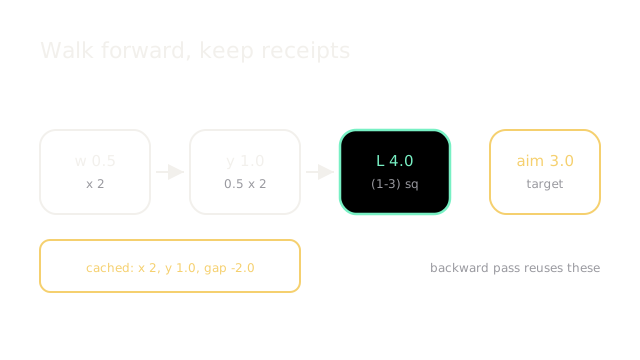
Backpropagation
Trace cached values, local derivatives and branch sums to compute weight gradients, then separate backpropagation from the optimizer update.
See it step by step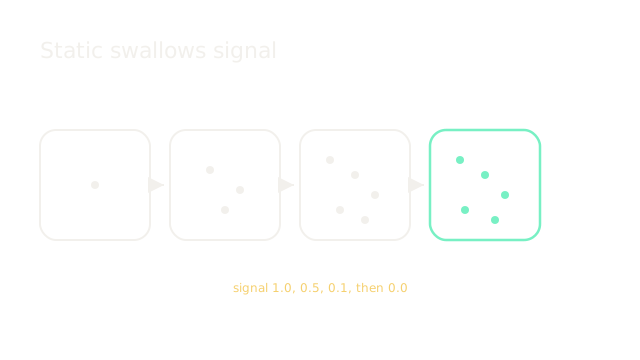
Diffusion Models
Learn a reverse process from known Gaussian corruption. Trace noise prediction, scaled sampling updates, guidance…
See it step by step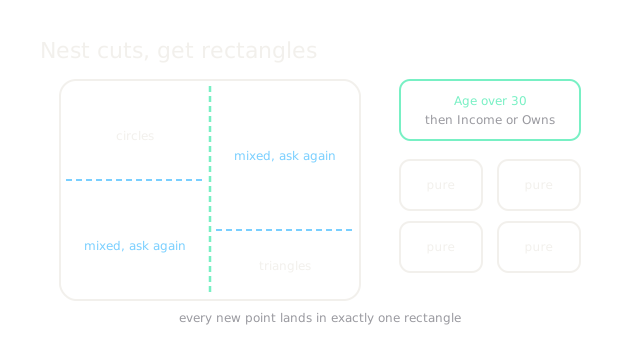
Decision Trees
Follow ten labelled samples through feature thresholds, measured impurity reduction and recursive regions, then trace a query…
See it step by step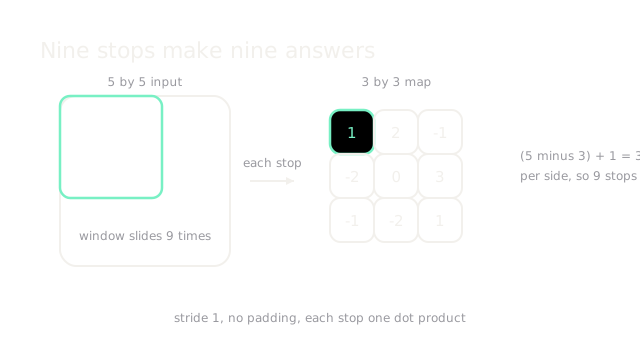
Convolution Operation
Trace a shared kernel through a checked numerical image, then inspect stride, padding, input-channel sums and the limits of shift correspondence.
See it step by step
Interactive playgrounds
Change a setting. Watch the model react.
Every playground computes its numbers from the real maths, so you see what the model does, including when you push it until it breaks.
Attention
Focus a token and watch how strongly it draws on every other one, in the graph and in the matrix at once.
Open the playgroundTransformer Decoding
Watch greedy decoding walk itself into a loop, then use temperature and truncation to get variety without nonsense.
Open the playgroundRetrieval-Augmented Generation (RAG)
See how injecting retrieved knowledge into a prompt grounds a model’s generation, saving it from hallucinating.
Open the playgroundTokenization (BPE)
Type any text and watch it get broken into subword tokens live, showing merge rules being applied step by step.
Open the playgroundThreshold, Confusion Matrix & ROC
Drag one threshold and watch the confusion matrix, precision, recall and the ROC point all move together.
Open the playgroundK-Means Clustering
Step through assign-then-recentre until the centroids stop moving. Then reseed badly and watch it converge confidently on an answer four times worse.
Open the playground
Interview prep
Rehearse the answer before the interview
Each answer opens with a short version you can say out loud, then the reasoning and trade-offs an interviewer will push on.
Generative AI
Explain the Transformer architecture at a high level.
The Transformer is a neural network architecture that replaces recurrence with a Self-Attention mechanism…
Generative AI
What is Retrieval-Augmented Generation (RAG) in one sentence?
Retrieval-Augmented Generation (RAG) grounds an LLM's response by retrieving relevant data from an external database…
Generative AI
Compare fine-tuning, RAG, and prompt engineering. When do you use each?
Prompt engineering shapes behavior via instructions; RAG injects dynamic external knowledge; Fine-tuning internalizes specific styles…
Core machine learning
Explain the bias-variance tradeoff and how model complexity affects it.
The bias-variance tradeoff describes the inverse relationship between a model's ability to minimize errors on training data (bias)…
Core machine learning
What is overfitting, and how can you recognize it?
Overfitting occurs when a model learns the training data's noise and details too well, failing to generalize to unseen data.
Generative AI
How would you design a production-grade RAG system and improve its quality?
A production RAG system uses hybrid retrieval (dense vectors + BM25), a cross-encoder reranker, and semantic chunking.
Browse by topic
Follow the topic you care about
The concept library spans the maths underneath, the classic methods and the systems built on top of them.
The full library
Every format in one place
Explanations, practice and reference sit side by side. Pick the format that fits the question in front of you.
Pick one idea. Watch it click.
See it in a diagram, test it in a playground, and come away able to explain it in your own words.
Have a project in mind?
Bring a Generative AI idea into focus.
See the services, deliverables and working process before starting a conversation with AI360Xpert.