Batch vs Real-Time Inference
Comparing latency-critical endpoints with throughput-optimized workloads.
Verdict: Use Real-Time Inference for interactive apps (chatbots, web UI); use Batch Inference for everything else (nightly jobs, embeddings, reporting) to maximize GPU utilization and slash costs.
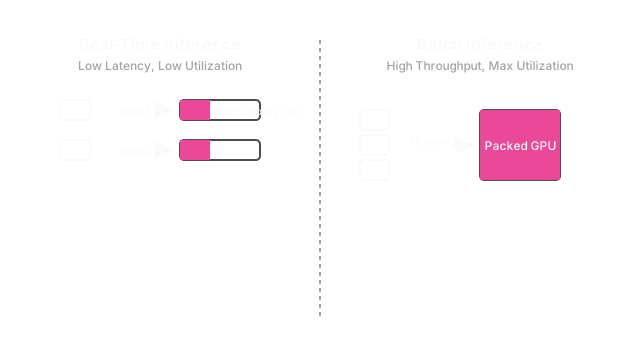
The Short Answer
Real-Time Inference receives a prompt and immediately begins generating an answer as fast as possible to send back to the user. It prioritizes low latency. Batch Inference receives a prompt, puts it in a queue, waits for 50 more prompts to arrive (or for a nightly schedule), and processes all 51 prompts simultaneously. It prioritizes high throughput and low cost.
Where They Differ
| Feature | Real-Time Inference | Batch Inference |
|---|---|---|
| Primary Metric | Time to First Token (TTFT) | Tokens per Second (Total Throughput) |
| GPU Utilization | Poor (Often < 30%) | Excellent (Near 100%) |
| Cost | Very High | Very Low (often 50% cheaper on API providers) |
| User Experience | Instant, interactive | Delayed (hours or days) |
Choose Real-Time Inference When
- You are building a chatbot or Copilot: If a user types a question into a web app, they expect an answer streaming back in under a second. You have no choice but to use real-time inference, even though it is highly inefficient for the hardware.
Choose Batch Inference When
- You are processing background data: If you need to summarize 100,000 legal contracts or generate vector embeddings for a database, no human is actively waiting on the other end. Submitting these as an asynchronous Batch Job allows the provider (like OpenAI or AWS) to run them during off-peak hours on packed GPUs, which is why API providers offer 50% discounts for batch workloads.
- You are running evaluation pipelines: When running LLM-as-a-Judge on thousands of log lines in CI/CD, processing them in huge batches reduces execution time and cost dramatically compared to firing sequential real-time requests.
What People Get Wrong
People assume running 1 prompt takes 1 second, so running 50 prompts must take 50 seconds. Due to the parallel nature of GPUs, running 1 prompt takes 1 second, but running a batch of 50 prompts simultaneously might only take 1.2 seconds total. Real-time inference leaves thousands of GPU cores sitting idle. If your architecture allows it, always queue and batch your work.