BERT vs GPT vs T5
Comparing encoder-only, decoder-only, and encoder-decoder transformer architectures.
Verdict: Use BERT for understanding tasks (classification, NER); use GPT for open-ended generation; use T5 for converting one sequence into another (translation, summarization).
The Short Answer
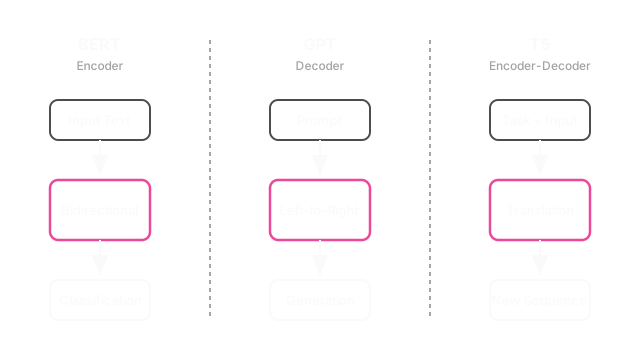
Though all three are built on the Transformer architecture, they use its parts differently. BERT is an encoder-only model designed to read text bidirectionally and understand it. GPT is a decoder-only model designed to read left-to-right and generate the next word. T5 is an encoder-decoder model designed to convert an input sequence into a completely new output sequence.
Where They Differ
| Feature | BERT (Encoder) | GPT (Decoder) | T5 (Encoder-Decoder) |
|---|---|---|---|
| Attention Mask | Bidirectional (can see future tokens in the input) | Causal (can only see past tokens) | Bidirectional encoder + Causal decoder |
| Training Objective | Masked Language Modeling (fill in the blank) | Causal Language Modeling (predict next word) | Span Corruption (predict missing spans) |
| Best Used For | Classification, NER, Sentiment Analysis, Extractive QA | Chatbots, Creative Writing, Code Generation | Translation, Summarization, Abstractive QA |
| Output Shape | One vector per input token | A new sequence of tokens | A new sequence of tokens |
Choose BERT When
- You need to classify or label text: If your task is "read this document and tell me if it's positive or negative", BERT's bidirectional context makes it incredibly accurate.
- You are building an embedding model: Dense retrieval models rely on the deep, two-way contextual embeddings that encoder architectures naturally produce.
Choose GPT When
- You need open-ended generation: GPT excels at continuing a prompt. If the task requires writing a paragraph, writing code, or holding a conversation, causal decoders are the industry standard.
- You are doing Few-Shot prompting: Decoder models have proven exceptionally good at in-context learning, adapting to patterns provided in the prompt without any gradient updates.
Choose T5 When
- Your task is strictly sequence-to-sequence: Translation (English to French) or summarization (long article to short paragraph) requires reading the entire input before deciding how to start generating the output. Encoder-decoders were explicitly designed for this.
What People Get Wrong
People often try to use GPT for tasks that BERT handles better, cheaper, and faster. You do not need a 7-billion parameter generative model to do binary sentiment classification on customer reviews; a fine-tuned 110-million parameter BERT model will often match its accuracy at a fraction of the latency and cost.