Diffusion vs Flow Matching
Comparing curved stochastic paths with straight continuous paths for generative modeling.
Verdict: Use Flow Matching for new state-of-the-art models to gain massive inference speedups; stick to standard Diffusion if you are building upon existing open-source checkpoints (like Stable Diffusion).
The Short Answer
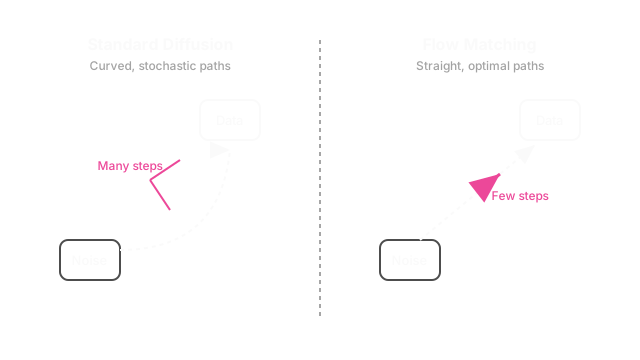
Standard Diffusion creates images by mapping data to noise along a curved, stochastic path, meaning the model must take dozens of tiny, careful steps to re-trace that curve backwards. Flow Matching (and its cousin Rectified Flow) forces the mapping to follow straight lines. Because straight lines are easier to predict, the model can generate high-quality images in far fewer steps.
Where They Differ
| Feature | Diffusion | Flow Matching |
|---|---|---|
| Path Trajectory | Curved / Stochastic | Straight / Deterministic (Optimal Transport) |
| Inference Steps Required | 20 to 50 steps | 1 to 4 steps |
| Mathematical Basis | Stochastic Differential Equations (SDEs) | Ordinary Differential Equations (ODEs) / Vector Fields |
| Simulation Cost | High (hard to approximate a curve with large steps) | Low (easy to follow a straight line) |
Choose Diffusion When
- You are relying on the open-source ecosystem: The tooling, ControlNets, and LoRAs built around standard diffusion models (like SDXL) are massive. If you need compatibility with community tools, stick to standard diffusion.
Choose Flow Matching When
- You are training a model from scratch: Flow matching is the modern upgrade to diffusion. By enforcing straight paths (via Optimal Transport), you inherently get a model that generates better images in fewer steps.
- You need ultra-fast inference: Because the path from noise to data is straight, ODE solvers (like Euler) can take massive leaps without falling off the path. This enables 1-step or 4-step generation without the heavy distillation required by older diffusion models.
What People Get Wrong
People often treat Flow Matching as a completely different paradigm that replaces Diffusion. In reality, it is a mathematically elegant generalization of Diffusion. You still start with pure noise and predict the vector pointing towards the clean image — you are simply structuring the training data so that those vectors form straight lines instead of chaotic curves. Modern models like Stable Diffusion 3 and Flux already use Flow Matching under the hood.