Long Context vs RAG
Comparing massive context windows with selective retrieval.
Verdict: Use Long Context Windows for analyzing single, massive documents (like a codebase or book) in one go; use RAG when you need to answer questions across a constantly updating library of thousands of documents.
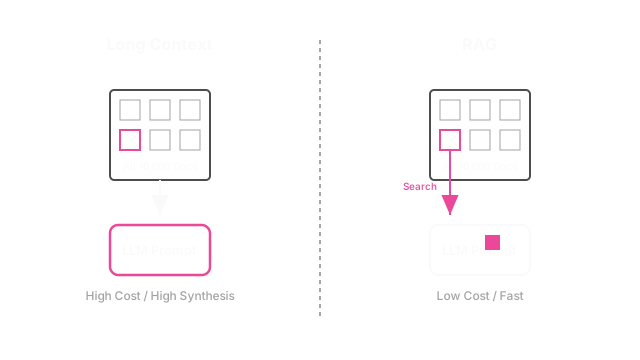
The Short Answer
Modern LLMs like Gemini 1.5 Pro boast massive Long Context Windows (up to 2 million tokens), allowing you to paste entire books or codebases directly into the prompt and ask questions about them. RAG takes a different approach: it stores your documents in a database, runs a search query to find the 5 most relevant paragraphs, and only pastes those 5 paragraphs into a much smaller prompt.
Where They Differ
| Feature | Long Context Windows | RAG |
|---|---|---|
| How data enters the model | All data pasted in at once | Only top search results pasted in |
| Cost per query | Extremely High (You pay for all 2M tokens every time you ask a question) | Very Low (You only pay for the retrieved paragraphs) |
| Cross-Document Synthesis | Perfect (Model can see everything simultaneously) | Poor (Only sees the fragments that matched the search) |
| Knowledge Updates | Clunky (Must re-paste everything) | Instant (Just add to the database) |
Choose Long Context When
- You need deep, cross-document reasoning: If your task is "Find all contradictions between Document A and Document B", RAG will likely fail because it relies on keyword/semantic matching to retrieve snippets. A long context model can read both documents entirely and compare them comprehensively.
- You are analyzing codebases: When asking a model to refactor a function, that function might rely on types and utilities scattered across 50 files. Pasting the entire repository into a long context window is often much more reliable than trying to retrieve the correct dependencies.
Choose RAG When
- You are building a production search engine: If you have 50,000 PDF reports, pasting them all into a prompt is impossible (they exceed the context window) and financially ruinous (it would cost $10+ per question in API fees). RAG narrows the 50,000 PDFs down to 1 page, making the API call cost fractions of a cent and return in 2 seconds.
- You need strict citations: Because RAG explicitly retrieves chunks of text from a database, it is trivial to show the user exactly which document the model used to formulate its answer, preventing hallucinations.
What People Get Wrong
People often claim that 1M+ token context windows have "killed" RAG. This shows a fundamental misunderstanding of unit economics. If an enterprise chatbot processes 10,000 queries a day against a company handbook, feeding the entire handbook into the prompt 10,000 times will bankrupt the project. RAG is fundamentally a cost and latency optimization layer that will always be necessary for scale.