Open-Weight vs Hosted API Models
Comparing models you download with models you rent by the token.
Verdict: Use Hosted APIs (like OpenAI) to build and validate your product instantly; switch to Open-Weight models (like Llama 3) if your data is highly sensitive, or if you hit massive scale and need to cut inference costs by hosting it yourself.
The Short Answer
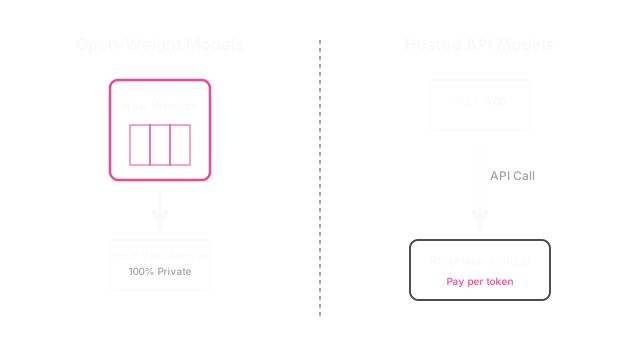
Hosted API Models (like GPT-4, Claude, Gemini) are massive, proprietary models running on the provider's servers. You pay per token to use them. Open-Weight Models (like Llama 3, Mistral, Qwen) allow you to download the actual trained neural network weights for free, meaning you can run them locally, modify them, and deploy them on your own servers without paying a per-token API tax.
Where They Differ
| Feature | Open-Weight Models | Hosted API Models |
|---|---|---|
| Data Privacy | 100% Private (Runs on your hardware) | Data is sent to a 3rd party server |
| Pricing Model | Fixed cost (You pay for the GPU hosting) | Variable cost (You pay per token) |
| Fine-Tuning | Deeply customizable (LoRA, QLoRA, full FT) | Limited (Provider-specific fine-tuning APIs) |
| Setup Effort | High (Requires DevOps, vLLM, scaling) | Zero (Just an API key) |
Choose Hosted API Models When
- You are just starting out: If you want to build a startup today, using OpenAI or Anthropic is the only logical choice. You get state-of-the-art intelligence instantly with zero DevOps overhead, allowing you to focus purely on product-market fit.
- You need extreme intelligence: While open-weight models are catching up rapidly, the absolute frontier models (for complex math, reasoning, and coding) are almost always locked behind proprietary APIs.
Choose Open-Weight Models When
- Data Privacy is legally mandated: If you are building an AI tool for a hospital (HIPAA compliance) or a defense contractor, you cannot send user data to OpenAI. You must download a model like Llama 3 and run it inside your own secure VPC.
- You hit massive scale: If you are processing millions of tokens per minute, API fees will crush your margins. Hosting an open-weight model yourself on AWS or RunPod is often 10x cheaper at scale.
- You need specialized fine-tuning: If you want to merge layers, mess with the internal representations, or build hyper-specialized agents, you need access to the raw weights.
What People Get Wrong
People often call Llama and Mistral "Open Source." They are not truly open source according to the OSI definition, because their training data and code are kept secret. They are Open-Weight, meaning they release the final product (the matrix of numbers) for you to use. This is an important distinction when considering the long-term maintainability of your tech stack.