Precision Formats Compared
Comparing FP32, FP16, BF16, and Int8 quantization.
Verdict: Train models in BF16 for the best balance of stability and speed; deploy models using INT8 or INT4 quantization to drastically cut server costs without noticeably degrading text quality.
The Short Answer
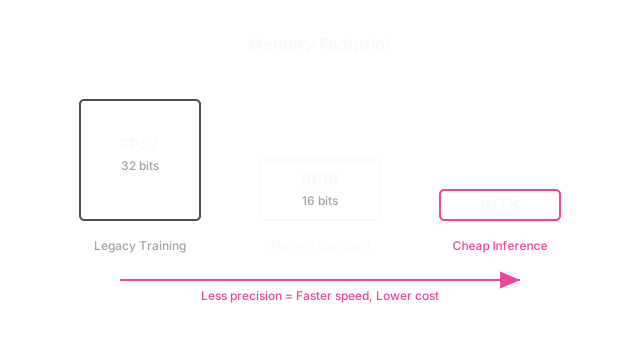
Precision refers to how many bits of memory a computer uses to store a single number (a neural network weight). FP32 (32 bits) is the traditional standard, offering massive decimal accuracy. FP16 and BF16 (16 bits) cut the memory in half. INT8 and INT4 (Quantization) compress the floating-point decimals into tiny whole numbers (integers), shrinking the model massively.
Where They Differ
| Format | Bits per parameter | Size of a 7B Model | Best Used For |
|---|---|---|---|
| FP32 (Float32) | 32 | 28 GB | Legacy architectures, scientific computing |
| FP16 / BF16 | 16 | 14 GB | Modern model training and base deployment |
| INT8 | 8 | 7 GB | High-quality, cost-effective inference |
| INT4 | 4 | 3.5 GB | Edge device deployment (laptops, phones) |
Choose BF16 When
- You are training a model: Training requires calculating gradients (tiny updates to the weights). If you use INT8, the gradients round down to zero, and the model stops learning. BF16 (Brain Float 16) is specifically designed by Google to have the same dynamic range as FP32, preventing training crashes while using half the memory.
Choose INT8 / INT4 (Quantization) When
- You are deploying a model for inference: Once a model is trained, it turns out that neural networks are incredibly resilient to "noisy" weights. Rounding the weights off (quantization) from 16 bits down to 8 or 4 bits drastically reduces VRAM requirements. This means you can fit a 70B parameter model on a single GPU instead of four, cutting your hosting costs by 75% while maintaining ~98% of the model's accuracy.
What People Get Wrong
People assume that cutting the precision in half (FP16 to INT8) cuts the intelligence in half. It doesn't. Modern models are vastly over-parameterized. Quantizing an LLM to INT4 generally results in less than a 2% drop in performance on major benchmarks, which is completely imperceptible to end-users, but allows the model to run twice as fast on much cheaper hardware.