Single Agent vs Multi-Agent
Comparing one monolithic agent with a team of specialized agents.
Verdict: Use a Single Agent for straightforward, linear tasks to save API costs and latency; use Multi-Agent architectures when tasks require conflicting personas, rigid verification, or massive, parallel workloads.
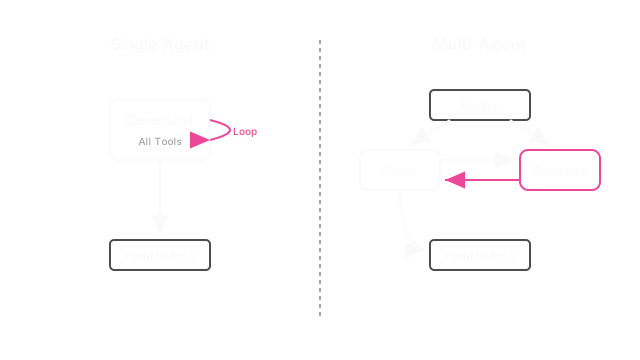
The Short Answer
A Single Agent is one LLM prompt equipped with a set of tools (Search, Calculator, etc.) running in a simple loop until it thinks the task is done. A Multi-Agent system splits the problem into distinct roles (e.g., a "Coder" agent and a "Reviewer" agent) that talk to each other, hand off state, and verify each other's work.
Where They Differ
| Feature | Single Agent | Multi-Agent |
|---|---|---|
| Architecture | Simple loop | Graph of interconnected nodes |
| System Prompt | Huge (must contain instructions for everything) | Small and specialized per node |
| Speed & Cost | Fast and cheap | Slow and expensive (heavy token usage) |
| Error Recovery | Poor (often gets stuck in a loop) | Excellent (Reviewer can reject the Coder's work) |
Choose a Single Agent When
- The task is linear: If the user just wants the AI to "Search the web for X and format it as a table", spinning up a multi-agent hierarchy of planners, workers, and reviewers is massive overkill. A single agent will do it in one shot for a fraction of the cost.
- You have severe latency constraints: Multi-agent debate can take 30 seconds to several minutes to converge. A single agent often finishes in 3–5 seconds.
Choose a Multi-Agent System When
- You need adversarial verification: LLMs are terrible at grading their own homework. If a single agent writes code, it usually thinks the code is perfect. In a multi-agent setup, forcing a distinct "Reviewer" agent (with a prompt that explicitly says "Your job is to find flaws") to grade the "Coder" drastically improves output quality.
- The tool list is massive: If your app has 50 tools, giving them all to one agent confuses it. It is better to use a "Router" agent that delegates the task to a "Database Expert" agent (which has the SQL tools) or a "Web Expert" agent (which has the browser tools).
What People Get Wrong
People often assume Multi-Agent systems are inherently smarter. They aren't. They are just a prompt-engineering trick to force the LLM to adopt narrow, hyper-focused personas sequentially rather than trying to juggle every requirement at once. This massively increases reliability at the cost of API tokens.