Boosted Trees vs Neural Networks on Tabular Data
Comparing state-of-the-art architectures for structured, tabular datasets.
Verdict: Always start with Boosted Trees for tabular data; only explore Neural Networks if your data is highly unstructured (images/text mixed in) or you have tens of millions of rows.
The Short Answer
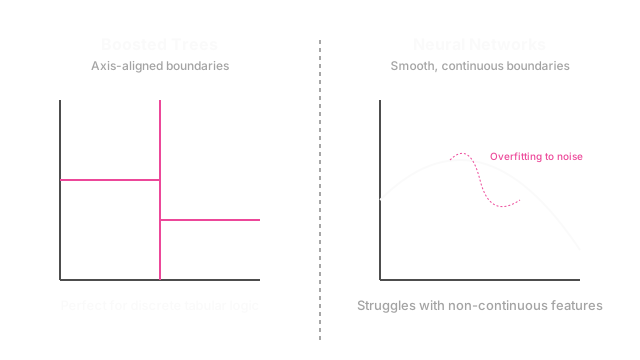
Despite deep learning conquering vision and text, Boosted Trees (like XGBoost, LightGBM, CatBoost) consistently outperform Neural Networks on structured tabular data (CSVs, databases). Trees naturally handle unnormalized data, missing values, and mixed types (categorical vs continuous) by drawing hard, axis-aligned boundaries. Neural Networks expect smooth, continuous data, forcing you into heavy preprocessing just to match a tree's baseline performance.
Where They Differ
| Feature | Boosted Trees | Neural Networks |
|---|---|---|
| Decision Boundary | Axis-aligned step functions (staircases) | Smooth, continuous curves |
| Data Requirements | Thrives on small to medium datasets ( rows) | Requires massive datasets to generalize |
| Preprocessing Required | Minimal (can handle missing/categorical data natively) | Massive (requires scaling, imputation, one-hot encoding) |
| Interpretability | High (Feature Importance is baked in) | Low (Black box) |
Choose Boosted Trees When
- You have standard business data: If your data looks like an Excel spreadsheet (User IDs, transaction amounts, categorical locations), Boosted Trees will almost always give you a higher accuracy out-of-the-box.
- You are constrained by training time: A LightGBM model can train on a million rows in seconds on a CPU. A neural network requires GPUs and takes significantly longer to tune and converge.
Choose Neural Networks When
- You have multi-modal data: If your tabular dataset includes unstructured data (e.g., a "User Profile Picture" or "Review Text" column alongside the transaction data), a deep learning architecture can seamlessly ingest embeddings from vision and text models.
- You have billions of rows: Trees eventually hit a performance asymptote. Given enough data, architectures like TabNet or simple deep MLPs can sometimes marginally surpass XGBoost because their capacity is unbounded.
What People Get Wrong
People often assume deep learning is strictly "better" or more advanced than tree-based methods. For tabular data, the inductive bias of a decision tree — splitting data into strict, orthogonal boxes — perfectly matches how tabular features actually interact. Neural networks try to draw smooth gradients across discrete categorical concepts, which mathematically makes little sense and leads to overfitting.