Word2Vec vs GloVe vs FastText
Comparing foundational word embedding techniques and how they capture semantic meaning.
Verdict: Use FastText if your dataset contains many rare words or morphologically rich languages; otherwise, pre-trained Word2Vec or GloVe embeddings offer excellent out-of-the-box semantic meaning.
The Short Answer
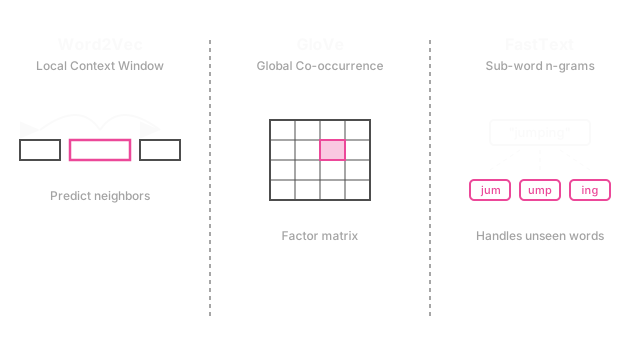
These are the three classic algorithms for turning words into dense vectors (embeddings). Word2Vec learns by sliding a small window over text and predicting adjacent words. GloVe counts how often every word appears with every other word across the whole corpus, then factors that massive matrix. FastText works like Word2Vec but breaks words down into sub-word chunks (n-grams), allowing it to understand words it has never seen before.
Where They Differ
| Feature | Word2Vec | GloVe | FastText |
|---|---|---|---|
| Core Concept | Predictive (Local context window) | Count-based (Global co-occurrence) | Predictive + Sub-words |
| Out-of-Vocabulary (OOV) | Fails (Cannot embed unseen words) | Fails (Cannot embed unseen words) | Succeeds (Builds vector from sub-words) |
| Morphological Awareness | None ("run" and "running" are entirely separate) | None | High (knows they share "run") |
| Training Speed | Fast | Very Fast | Slower (due to n-gram overhead) |
Choose Word2Vec or GloVe When
- You are prototyping a basic NLP task: If you need a simple embedding layer for a classification model and don't want to use a heavy Transformer, downloading standard pre-trained GloVe or Word2Vec vectors is incredibly efficient. (Practically, they perform so similarly that the choice between them rarely matters).
Choose FastText When
- You have highly specific or noisy vocabulary: If you are analyzing social media text full of typos ("coooool") or domain-specific jargon, FastText can still generate a meaningful embedding based on the recognizable character chunks inside the word.
- You are working in agglutinative languages: Languages like German or Turkish string words together to create new ones. FastText's sub-word embeddings handle this naturally.
What People Get Wrong
People often think these embeddings have been entirely replaced by BERT and modern LLMs. While LLMs produce contextual embeddings (where "bank" has a different vector in "river bank" vs "bank account"), static embeddings like FastText are still heavily used in production search engines and recommendation systems because they require essentially zero compute at inference time.