AI Governance Frameworks
Governance is how you translate vague ethical principles into concrete organizational rules so that a company doesn't accidentally build or buy harmful AI.
Why Does This Exist?
Engineers cannot solve ethical problems entirely with code. If a company claims to care about "Fairness" but evaluates its data scientists solely on "Model Accuracy," the models shipped will prioritize accuracy over fairness every time.
AI Governance Frameworks exist to align technical execution with legal, ethical, and business requirements. They provide structured methodologies (like the NIST AI Risk Management Framework or the EU AI Act) to identify risks, assign accountability, and mandate processes like documentation, audits, and human oversight. Without governance, Responsible AI is just a poster on the wall; with governance, it becomes an auditable checklist.
Think of It Like This
Think of AI Governance like building codes for skyscrapers.
The structural engineer (the data scientist) knows how to make the building stand up. But the building code (the governance framework) dictates that the building must also have fire escapes, wheelchair ramps, and earthquake resistance.
The code isn't there to teach the engineer how to pour concrete; it's there to mandate that safety and accessibility are not skipped to save time or money.
How It Actually Works
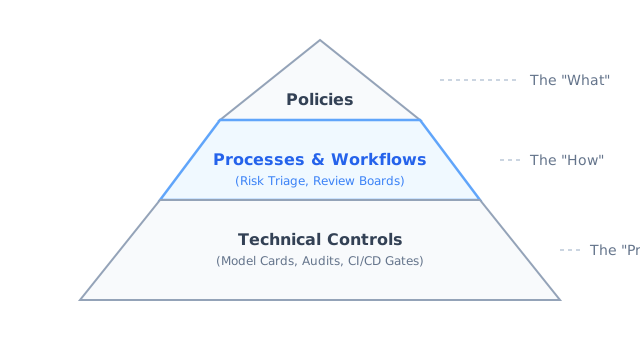
While specific frameworks differ, almost all modern AI Governance systems are built around a risk-based approach structured in three layers:
1. Policies (The "What")
These are executive-level directives. They define the organization's risk appetite and absolute red lines.
- Example Policy: "We will not deploy facial recognition for surveillance."
- Example Policy: "All high-risk models must undergo a third-party fairness audit before deployment."
2. Processes (The "How")
These are the operational workflows that ensure the policies are followed. They dictate who must sign off on a model and what evidence they need.
- Model Inventories: A centralized registry of every model running in production, what it does, and who owns it.
- Risk Triage: A questionnaire filled out at project inception to determine if a model is Low Risk (e.g., a spam filter) or High Risk (e.g., a resume screener). High-risk models trigger stricter oversight.
- Review Boards: A cross-functional committee (legal, engineering, ethics) that reviews high-risk models before they go live.
3. Technical Controls (The "Evidence")
These are the engineering artifacts that prove the processes were followed.
- Model Cards: Documentation of the model's performance and limitations.
- Automated Testing: CI/CD pipelines that explicitly test for data drift or bias before allowing a model to deploy.
- Access Logs: Cryptographic proof of who approved a deployment and who accessed a sensitive dataset.
Standardized Frameworks
Instead of inventing governance from scratch, most organizations adopt established frameworks:
- NIST AI RMF: A voluntary US framework focused on four core functions: Map, Measure, Manage, and Govern.
- EU AI Act: A binding legal framework that categorizes AI systems by risk (Unacceptable, High, Limited, Minimal) and imposes strict legal requirements (and massive fines) on High-Risk systems.
Code
Governance itself is not code, but Compliance-as-Code is how governance scales. You can enforce governance policies programmatically in your deployment pipeline.
def check_deployment_governance(model_metadata, required_approvals): """ A programmatic CI/CD gate enforcing a governance policy: High-risk models cannot be deployed without Legal and Ethics sign-off. """ risk_tier = model_metadata.get('risk_tier') signatures = model_metadata.get('signatures', []) if risk_tier == 'High': missing = [role for role in required_approvals if role not in signatures] if missing: raise PermissionError(f"GOVERNANCE BLOCK: Missing signatures from {missing}") # Check for mandatory Model Card if not model_metadata.get('model_card_url'): raise ValueError("GOVERNANCE BLOCK: No Model Card attached.") return "Deployment Authorized"
# Example usage:# meta = {'risk_tier': 'High', 'signatures': ['Engineering'], 'model_card_url': 'link'}# check_deployment_governance(meta, ['Engineering', 'Legal', 'Ethics'])# -> PermissionError: GOVERNANCE BLOCK: Missing signatures from ['Legal', 'Ethics']Watch Out For
Governance Theater
Implementing complex review boards and endless checklists that everyone just rubber-stamps to get their code shipped. If the governance process has never delayed or blocked a risky model, it is likely theater, not actual governance.
One-size-fits-all processes
Forcing a low-risk internal tool (like an email categorizer) to go through the same 6-month ethical review process as a high-risk medical diagnostic tool. This destroys engineering velocity and breeds resentment. Governance must be risk-proportionate.
The Quick Version
- AI Governance ensures an organization builds and buys AI responsibly by aligning technical work with ethical and legal standards.
- It operates on three levels: Policies (executive rules), Processes (workflows and review boards), and Technical Controls (model cards and CI/CD gates).
- Modern governance is risk-based: high-risk models face intense scrutiny, while low-risk models move quickly.
- Standardized frameworks like the NIST AI RMF and the EU AI Act provide blueprints so organizations do not have to invent rules from scratch.