Feature Stores
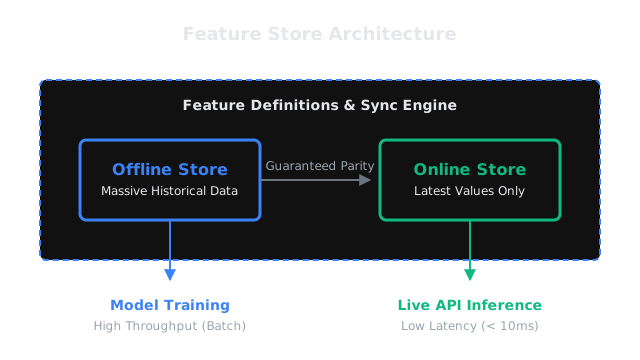
Data Scientists compute features slowly in a data warehouse (Offline). Software Engineers need to fetch those same features in 10 milliseconds for the live app (Online). A Feature Store bridges this gap, guaranteeing that the 'average_spend_30d' calculated during training is mathematically identical to the one fetched during live inference.
Why Does This Exist?
When a Data Scientist trains a model to predict credit card fraud, they write a complex SQL query to calculate a feature like transaction_count_last_24h. They run this query on a massive Data Warehouse (like Snowflake or BigQuery). It takes 15 minutes to run, but that's fine for offline training.
A month later, the model is deployed. A customer swipes their credit card. The live API needs to run the model right now, which means it needs the transaction_count_last_24h feature right now. It cannot wait 15 minutes for Snowflake to run a query.
Historically, a Backend Engineer would have to rewrite the Data Scientist's SQL logic in Java or Go to run against a fast transactional database.
If the Backend Engineer makes a tiny mistake in the rewrite (e.g., they calculate the 24-hour window using > instead of >=), the live model receives slightly different numbers than it was trained on. This is called Training-Serving Skew, and it quietly destroys model accuracy.
Feature Stores were invented to solve this exact problem.
Think of It Like This
Think of It Like This
Imagine a restaurant. The prep cook (Data Scientist) spends hours chopping vegetables and making complex sauces in the massive prep kitchen in the back (the Offline Store). When a customer orders a meal, the line cook (Backend Engineer) doesn't have time to chop vegetables. They grab the pre-chopped ingredients from the fast, small line refrigerators right next to the stove (the Online Store).
A Feature Store is the system that ensures the ingredients in the front fridge are perfectly synchronized with the prep kitchen in the back.
How It Actually Works
A modern Feature Store (like Feast, Tecton, or Vertex AI Feature Store) is not a single database. It is a data management layer that sits on top of two different databases:
1. The Offline Store (For Training)
This is your massive Data Warehouse (Snowflake, BigQuery, S3). It stores terabytes of historical feature values. When a Data Scientist wants to train a model, they ask the Feature Store for "all features for these users across the last two years." The Feature Store generates a massive, point-in-time-correct CSV/Parquet file.
2. The Online Store (For Inference)
This is an ultra-fast, low-latency database (Redis, DynamoDB, Cassandra). It does not store history. It only stores the single most recent feature value for every entity. When a credit card is swiped, the API asks the Feature Store: "Give me the features for User 123." The Feature Store hits Redis and returns the vector in 10 milliseconds.
The Synchronization Engine
The magic of the Feature Store is the sync. You define the feature logic exactly once (usually in Python or SQL). The Feature Store automatically computes the historical values and puts them in the Offline Store, while continuously updating the latest values and pushing them to the Online Store. Parity is mathematically guaranteed.
Code
Here is how you interact with Feast (the most popular open-source Feature Store) to fetch features for live inference.
from feast import FeatureStoreimport pandas as pd
# 1. Connect to the Feature Store registrystore = FeatureStore(repo_path=".")
# 2. A customer swipes their card. The backend knows their user_id.entity_rows = [ {"user_id": 1001}]
# 3. Fetch the required features from the ultra-fast Online Store (e.g., Redis)# Notice we don't have to write any SQL to calculate these! # We just ask for them by name.features = store.get_online_features( features=[ "user_stats:transaction_count_24h", "user_stats:average_spend_30d", "user_stats:account_age_days" ], entity_rows=entity_rows).to_dict()
# 4. Pass the fetched features directly to the ML modelmodel_input = [[ features["transaction_count_24h"][0], features["average_spend_30d"][0], features["account_age_days"][0]]]
prediction = my_fraud_model.predict(model_input)Watch Out For
Point-in-Time Leakage.
When generating the historical training set from the Offline Store, you must join the features exactly as they existed at the moment of the event. If a user committed fraud on Tuesday, you must join their average_spend exactly as it was on Tuesday morning. If you accidentally join their average_spend as it exists today (Friday), the model will learn from the future. This is called target leakage. A good Feature Store explicitly handles "Point-in-Time Joins" to prevent this.
The Quick Version
- Training-Serving Skew happens when the code used to calculate features for training differs from the code used for live inference.
- Feature Stores solve this by allowing you to define feature logic once.
- They manage an Offline Store (like Snowflake) for pulling massive historical datasets for training.
- They manage an Online Store (like Redis) for fetching the latest feature values in milliseconds for live predictions.
- They guarantee mathematical parity between the two environments.