GloVe
An embedding technique that generates dense word vectors by training on global word-word co-occurrence statistics across an entire corpus.
Why Does This Exist?
In the early 2010s, there were two dominant ways to represent text mathematically:
- Global Matrix Factorization: Methods like LSA (Latent Semantic Analysis) looked at the entire dataset at once. They captured global statistics well but performed poorly on analogy tasks (like King - Man + Woman = Queen).
- Local Context Windows: Methods like Word2Vec slid a small window across sentences, predicting neighboring words. They were incredible at semantic analogies, but they completely ignored the global statistics of the corpus because they only ever looked at 5 words at a time.
GloVe (Global Vectors for Word Representation), introduced by Stanford in 2014, was designed to be the best of both worlds. It explicitly leverages global statistical information while still producing vectors that capture fine-grained semantic meaning and analogy mathematics.
Think of It Like This
Think of It Like This
Imagine trying to map the relationships between different politicians.
A local context window approach (like Word2Vec) would watch them at a party. It notices that Alice and Bob are standing near each other, so it moves their vectors closer. But it misses the fact that Alice and Charlie never attend the same parties.
A global co-occurrence approach (like GloVe) doesn't watch them at the party. Instead, it asks for the guest list of every party that happened all year. It builds a massive spreadsheet of exactly how many times Alice attended an event with Bob, Charlie, and Dave. It then mathematically compresses that giant spreadsheet into a small coordinate map. Because it started with global data, the final map is much more robust.
How It Actually Works
The core of GloVe is the co-occurrence matrix.
1. Building the Matrix
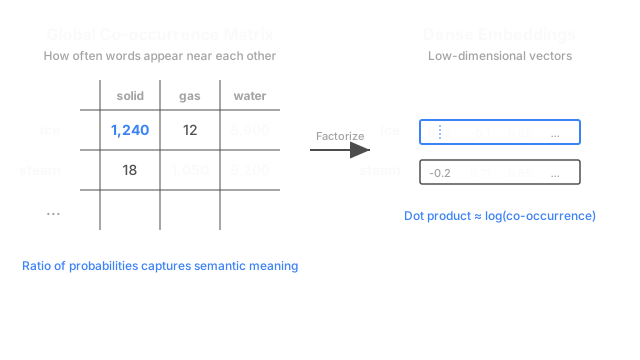
GloVe scans the entire training corpus and builds a massive grid. The rows are words, the columns are words, and the cells contain a count of how often those two words appeared near each other (e.g., within 10 words of each other) in the text.
If "ice" and "solid" appear near each other 1,000 times, the cell (ice, solid) contains the number 1,000.
2. The Core Insight: Ratios of Probabilities
The Stanford researchers realized that the raw counts aren't what carries the semantic meaning; the ratio of the counts is what matters.
Consider the words "ice" and "steam".
- The word "solid" will appear near "ice" frequently, but rarely near "steam". The ratio of their probabilities is large.
- The word "gas" will appear near "steam" frequently, but rarely near "ice". The ratio is small.
- The word "water" will appear near both of them frequently. The ratio is close to 1.
- The word "fashion" will appear near neither of them. The ratio is also close to 1.
GloVe proves that semantic meaning is entirely encoded in these ratios.
3. Training the Embeddings
GloVe defines a loss function that forces the dot product of two word vectors to equal the logarithm of their co-occurrence probability. It uses stochastic gradient descent to adjust the vectors until this mathematical relationship holds true across the entire vocabulary.
Unlike Word2Vec, which trains on a fake prediction task, GloVe directly optimizes the vectors to recreate the global co-occurrence matrix.
Code
You rarely train GloVe from scratch. Because it relies on global statistics, you get the best results by downloading pre-trained vectors that Stanford trained on billions of words from Wikipedia and Common Crawl.
In Python, you can easily load these pre-trained vectors using gensim.
import gensim.downloader as api
# Download the pre-trained GloVe model (trained on Wikipedia, 100 dimensions)# This downloads a ~400MB file the first time you run itglove_vectors = api.load("glove-wiki-gigaword-100")
# We can perform the famous vector arithmetic# King - Man + Woman = ?result = glove_vectors.most_similar(positive=['woman', 'king'], negative=['man'], topn=1)print(result)# -> [('queen', 0.76985)]
# Find the similarity between two specific wordssimilarity = glove_vectors.similarity('frog', 'toad')print(f"Similarity (frog, toad): {similarity:.3f}")# -> Similarity (frog, toad): 0.812Watch Out For
Memory intensive to train.
Building the global co-occurrence matrix requires a massive amount of RAM. A vocabulary of 400,000 words requires a matrix of , which has 160 billion entries. While sparse matrix implementations help, GloVe is significantly more memory-intensive to train from scratch than Word2Vec.
Still static embeddings.
Like Word2Vec, GloVe assigns exactly one vector to each word. It cannot distinguish between "a bank account" and "a river bank". If you need context-aware embeddings, you must use a modern transformer model.
The Quick Version
- GloVe (Global Vectors) is an embedding algorithm that captures semantic meaning.
- It works by constructing a massive word-word co-occurrence matrix across the entire dataset.
- It optimizes word vectors so that their dot product equals the logarithm of how often they appear together.
- It combines the robust global statistics of matrix factorization with the semantic arithmetic abilities of Word2Vec.
- In practice, most developers use pre-trained GloVe vectors rather than training their own.