Inference Engines
You don't serve production traffic by running a Python script. You use a massive, hyper-optimized C++ server designed specifically to squeeze every last drop of performance out of a GPU.
Why Does This Exist?
In the early days of machine learning, deploying a model meant writing a Flask or FastAPI server in Python. When a user sent an HTTP request, the Python code would hand the data to PyTorch, run the math, and return the answer.
Today, if you try to serve a 70-Billion parameter LLM using a basic Python script, you will achieve incredibly low throughput (maybe 2 users per second) and waste massive amounts of expensive GPU memory.
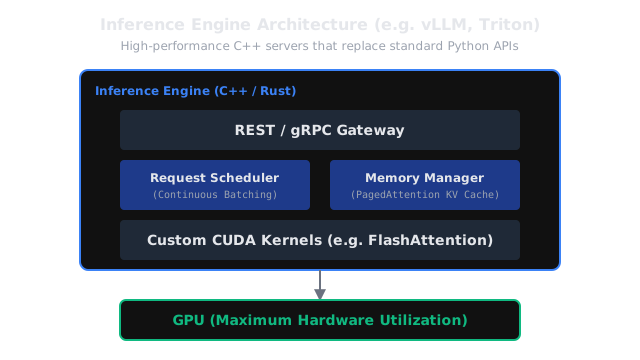
To serve ML at scale, the industry relies on Inference Engines. These are dedicated, hyper-optimized backend servers usually written in C++ or Rust (with Python bindings). They do not just route HTTP traffic; they take complete control of the GPU hardware to execute the math as fast as physically possible.
Think of It Like This
Think of It Like This
Imagine you want to race a Formula 1 car.
A standard Python REST API is like letting a teenager drive the F1 car. They know how to turn the steering wheel and press the pedals, but they are going to drive at 40 mph and grind the gears.
An Inference Engine is a professional F1 driver. It knows exactly how to manage the tire temperature, when to shift gears, and how to draft. It takes the exact same car (your model) on the exact same track (the GPU) but achieves 5x the speed simply through perfect mechanical execution.
What an Inference Engine Actually Does
Modern inference engines (like vLLM, TGI, TensorRT-LLM, and Triton Inference Server) provide four critical performance features that you cannot easily replicate in standard PyTorch:
1. Advanced Batching
As discussed in continuous-batching and dynamic-batching, an inference engine manages the queues of incoming users. It intelligently groups them together, injects new users mid-flight, and packs the GPU matrices as tightly as possible to maximize throughput.
2. Custom CUDA Kernels
Standard PyTorch operations (like Matrix Multiplication) are generalized to work for everyone. Inference engines use hand-written, hyper-optimized CUDA code designed specifically for LLMs. For example, they replace standard Attention math with FlashAttention, a custom kernel that runs dramatically faster by minimizing memory reads.
3. Memory Management (PagedAttention)
The biggest bottleneck in LLM serving is storing the memory of the conversation (the KV Cache). Standard PyTorch allocates a massive, contiguous block of memory for this, wasting up to 50% of the VRAM due to fragmentation. Inference engines like vLLM use PagedAttention, dividing the memory into tiny blocks (like an operating system pages RAM), virtually eliminating memory waste and allowing you to serve 3x more users on the same GPU.
4. Tensor Parallelism
If a model is too big to fit on one GPU, you must split it across multiple GPUs. Writing the network synchronization code to make two GPUs compute the same layer simultaneously is a nightmare. Inference engines handle Tensor Parallelism out of the box; you just pass a flag --tensor-parallel-size 4, and it handles the complex networking automatically.
The Big Players
There are generally two types of engines you should know:
- General Purpose Engines: (e.g., Nvidia Triton, TorchServe). These are used to serve any type of model—Computer Vision, Audio, Tabular, etc. They excel at dynamic batching.
- LLM-Specific Engines: (e.g., vLLM, Hugging Face TGI, TensorRT-LLM). These are purpose-built strictly for text generation. They include Continuous Batching and PagedAttention, which are useless for computer vision but absolutely critical for LLMs.
Code
You rarely write the code for an Inference Engine. You install it as a pre-compiled binary or a Docker container, and pass it your model weights.
# Example: Starting Hugging Face's Text Generation Inference (TGI) via Docker
docker run --gpus all --shm-size 1g -p 8080:80 \ -v /path/to/my/model:/data \ ghcr.io/huggingface/text-generation-inference:latest \ --model-id /data \ --max-concurrent-requests 512 \ --max-batch-prefill-tokens 4096Watch Out For
The Proprietary Trap.
Nvidia's TensorRT-LLM is arguably the fastest inference engine on earth. However, it requires you to compile your model specifically for TensorRT, and it locks you firmly into the Nvidia hardware ecosystem. Open-source engines like vLLM are slightly slower, but they can run on Nvidia GPUs, AMD GPUs, and even Google TPUs without changing your model format. Choose your engine based on your willingness to be locked into a specific hardware vendor.
The Quick Version
- Standard Python REST APIs are too slow and inefficient for heavy ML workloads.
- Inference Engines are highly optimized servers (vLLM, TGI, Triton) that take complete control of the GPU.
- They drastically increase performance through Continuous Batching, FlashAttention, and PagedAttention.
- They make deploying massive models across multiple GPUs (Tensor Parallelism) trivial.
- LLMs require different, specialized engines than standard Computer Vision models.