Meta-Learning
Train a starting point across many tasks, not a solution to one, so adapting to any new related task takes only a handful of gradient steps.
Why Does This Exist?
A robotics lab trains a grasping policy for a warehouse arm, and the arm needs to pick up a new product line every few weeks — a different shape, weight, and surface texture each time. Training a grasping model from scratch for each new product takes days of practice runs. The business can't wait days every time the product catalog changes.
Transfer learning helps: start from a model trained on the previous product and fine-tune. But that still assumes a reasonable amount of new practice data, and it optimizes for being good at one specific starting point, not for being easy to adapt from. What the warehouse actually needs is a starting point deliberately chosen because a handful of grasps on a brand-new product is enough to specialize it well — not a starting point that happens to be good at yesterday's product and might or might not adapt fast to tomorrow's.
Meta-learning trains for exactly that property. Instead of optimizing to perform well on one task, it optimizes a starting point across many tasks so that a short burst of adaptation on any new, related task reaches good performance.
Think of It Like This
A chef who has cooked many cuisines, not mastered one
A chef who has spent years cooking only French cuisine can produce excellent French food, but handed a new cuisine entirely, that narrow experience transfers unevenly. A chef who has cooked reasonably well across dozens of different cuisines has built a different kind of skill: recognizing quickly what's structurally similar across a new, unfamiliar cuisine and what needs to be figured out from scratch, adapting within a few attempts rather than months.
The second chef isn't necessarily better at any one cuisine on day one. They're faster at becoming good at a new one. Meta-learning trains for that second kind of skill directly, across a whole distribution of tasks, rather than mastery of any single one.
How It Actually Works
Two nested loops: inner adaptation, outer meta-training
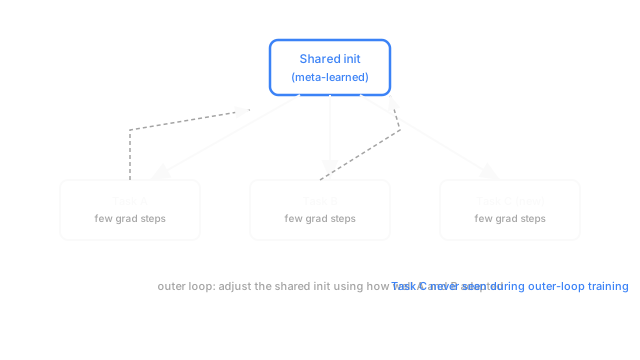
Meta-learning training runs over a distribution of tasks, not one fixed dataset. Each training round samples a task, then runs an inner loop: a handful of ordinary gradient steps starting from the current shared parameters, adapting to that one task. What actually gets updated by the outer loop is the shared starting point itself — updated based on how well the inner loop's result performed, not based on the inner loop's own gradients directly.
is the shared starting point, is one inner-loop gradient step adapting to task , and the outer objective evaluates the adapted parameters, not itself. This is MAML (Model-Agnostic Meta-Learning): the outer loop is explicitly optimizing "how good is as a starting point for a quick adaptation," which is a fundamentally different question than "how good is directly."
Prototypical networks: a simpler, non-gradient alternative
MAML's inner loop still runs gradient descent, which means differentiating through an optimization process — expensive, and finicky to get stable. Prototypical networks sidestep this for classification specifically: instead of adapting parameters at all, average a handful of labeled examples per class into one prototype vector per class, and classify a new example by whichever prototype it's nearest to in the learned embedding space. What the outer loop actually trains is the embedding function — the mapping that makes same-class examples land close together and different-class examples land far apart — so that averaging a few examples into a prototype is a meaningful operation in that space. No inner-loop gradient step happens at all; the adaptation is just an average.
Why a meta-learned start adapts faster than a random one
A randomly initialized model has no reason to be close to any particular task's optimum, so a few gradient steps from there barely move the loss. A meta-learned starting point was explicitly selected because it sits somewhere that a few steps do move substantially — not because it happens to already solve the new task, but because the outer loop rewarded exactly this property across many related tasks during training.
Code
One gradient step from a random starting point versus one gradient step from a meta-learned starting point, on the same new task.
import numpy as np
x_train = np.linspace(-3, 3, 10)new_task_w = 2.1 # this task's true slopey_train = new_task_w * x_train
def loss(w: float, x: np.ndarray, y: np.ndarray) -> float: return float(np.mean((w * x - y) ** 2))
def grad(w: float, x: np.ndarray, y: np.ndarray) -> float: return float(np.mean(2 * (w * x - y) * x))
for name, w0 in (("random init", -5.0), ("meta-learned init", 2.0)): before = loss(w0, x_train, y_train) w_after = w0 - 0.01 * grad(w0, x_train, y_train) after = loss(w_after, x_train, y_train) print(f"{name}: loss before = {before:.3f}, after one step = {after:.3f}")# -> random init: loss before = 184.837, after one step = 158.721# -> meta-learned init: loss before = 0.037, after one step = 0.031The meta-learned starting point begins nearly 5,000 times closer to this new task's optimum than the random one, because it was placed at the mean of a family of related tasks rather than an arbitrary point. One gradient step barely dents the random start; from the meta-learned start, the model is already close to done.
Watch Out For
Expecting meta-learning to work across unrelated tasks
A meta-learned starting point is only easy to adapt from for tasks that resemble the training task distribution. Handed a task genuinely unlike anything seen during meta-training, the "good starting point" property doesn't transfer, and adaptation can be no faster than starting from scratch. Meta-learning is a bet on task similarity, not a general-purpose speedup.
Treating the inner-loop learning rate as fixed and unimportant
MAML's inner loop is sensitive to its own learning rate in a way that's easy to overlook, since it's a hyperparameter of a hyperparameter. Too large and a few inner steps overshoot the task's optimum; too small and the adaptation the outer loop was optimizing for never actually happens within the step budget. Tune the inner-loop learning rate as carefully as the outer-loop one, not as an afterthought.
The Quick Version
- Meta-learning optimizes a starting point across a distribution of tasks, so a short adaptation on any new, related task reaches good performance quickly.
- MAML's outer loop evaluates parameters after a simulated inner-loop gradient step, directly optimizing for fast adaptability rather than for solving one fixed task.
- Prototypical networks skip gradient-based adaptation entirely for classification, learning an embedding space where averaging a few examples into a prototype is enough.
- A meta-learned starting point only helps for new tasks that resemble the training task distribution — it isn't a general-purpose speedup.