Monte Carlo Dropout (MC Dropout)
What if you could turn one model into a massive ensemble of thousands of models for free? Just leave Dropout turned on while you make predictions.
Why Does This Exist?
In modern Machine Learning, we know that the only reliable way to detect when a model is hallucinating (Epistemic Uncertainty) is to use deep-ensembles or bayesian-neural-networks.
But both of those methods are incredibly expensive. Training 5 separate neural networks takes 5x the compute, and running 5 models in production takes 5x the RAM. For massive models, this is financially impossible.
In 2016, researcher Yarin Gal made a brilliant mathematical discovery: You already have a massive ensemble of models built into your network, and it costs exactly $0 to use.
Almost all neural networks are trained using a regularization technique called Dropout, which randomly disables (drops) a percentage of neurons during training to prevent overfitting. Standard practice is to turn Dropout off during inference (production). Yarin Gal proved that if you simply leave Dropout on during inference, you create a mathematically rigorous approximation of a Bayesian Neural Network for free. This is called Monte Carlo Dropout (MC Dropout).
Think of It Like This
Think of your neural network like a corporate committee of 100 experts sitting in a room, trying to make a decision.
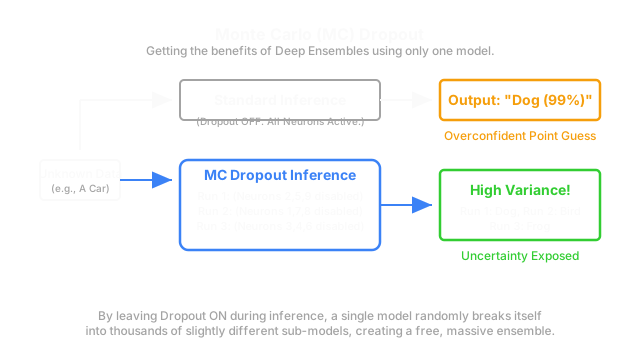
Standard Inference (Dropout OFF): All 100 experts vote at exactly the same time. The committee is incredibly powerful, but if they face an unknown problem, the loudest voices dominate the room, resulting in an overconfident, wrong decision.
MC Dropout (Dropout ON): You ask 20 experts to leave the room. The remaining 80 vote. You record the answer. Then you bring those 20 back, and kick a different random 20 experts out of the room. They vote again. You do this 10 times. If the problem is easy, every random configuration of 80 experts will reach the exact same conclusion. If the problem is unknown (Out-of-Distribution), the different configurations will result in wildly different votes, instantly exposing their uncertainty.
How It Actually Works
MC Dropout is identical to Deep Ensembles in theory, but completely different in execution.
1. The Single Model
Instead of training 5 separate models, you train a single model with standard Dropout (e.g., dropping 20% of neurons per layer).
2. Standard Inference vs MC Inference
Normally, when you deploy a model, you call model.eval() in PyTorch. This permanently locks all the weights and turns Dropout off. The model becomes deterministic (1 input always equals the exact same 1 output).
In MC Dropout, you manually leave the Dropout layers in "training mode." The model becomes stochastic (random).
3. Sampling the Unknown
When a user uploads a picture of a Car (unknown data), you run the image through the network 10 times.
- Run 1: Neurons 4, 12, and 89 are randomly disabled. The model predicts "Dog".
- Run 2: Neurons 2, 7, and 15 are randomly disabled. The model predicts "Bird".
- Run 3: Neurons 9, 31, and 42 are randomly disabled. The model predicts "Frog".
By temporarily erasing random parts of the model's brain, you force the model to rely on different mathematical pathways. Because the Car doesn't actually exist in any of those pathways, the predictions wildly diverge. You calculate the variance across the 10 runs, detect high Epistemic Uncertainty, and reject the prediction.
Code
Implementing MC Dropout in PyTorch is as simple as turning Dropout on during inference.
import torchimport numpy as np
def enable_dropout(model): """ Forces all Dropout layers to remain active, even if the model is otherwise in eval() mode. """ for m in model.modules(): if m.__class__.__name__.startswith('Dropout'): m.train()
def mc_dropout_predict(model, input_data, num_samples=10): # 1. Put model in eval mode, but manually turn Dropout back on model.eval() enable_dropout(model) predictions = [] # 2. Run the exact same input through the model 10 times with torch.no_grad(): for _ in range(num_samples): # Because Dropout is on, the model is slightly different every loop prob = model(input_data) predictions.append(prob.numpy()) predictions = np.array(predictions) # 3. Calculate Mean (Final Guess) and Variance (Uncertainty) mean_prediction = np.mean(predictions, axis=0) epistemic_uncertainty = np.var(predictions, axis=0) return mean_prediction, epistemic_uncertaintyWatch Out For
The Calibration Tradeoff
While MC Dropout is practically free to train (compared to Deep Ensembles), it is not free during inference. You still have to run the forward pass 10 or 20 times to get a stable variance calculation. More importantly, empirical studies have shown that MC Dropout is slightly less calibrated than true Deep Ensembles. A true Deep Ensemble explores completely different local minima in the loss landscape, whereas MC Dropout only explores the immediate area around a single minimum.
The Quick Version
- Training multiple models (
deep-ensembles) or Bayesian models is too expensive for most production environments. - MC Dropout simulates a massive ensemble using only one model.
- It works by leaving the Dropout regularization layers turned ON during inference.
- By running the same data through the network multiple times with different random neurons disabled, you create multiple "sub-models."
- If the data is unknown (Out-of-Distribution), the sub-models will violently disagree with each other, exposing the model's epistemic uncertainty.