Agent Harness Design
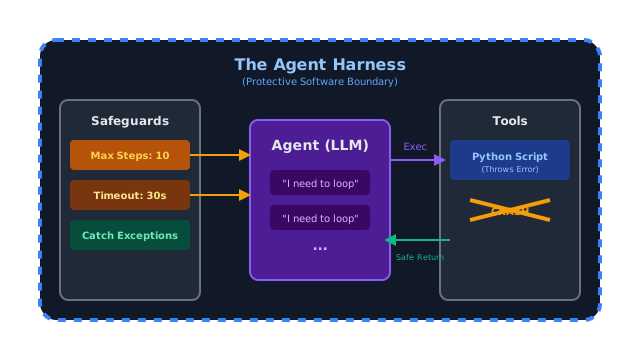
You can't just unleash an agent into a production database and hope it behaves. An Agent Harness is the strict software boundary that catches errors, logs token usage, manages timeouts, and prevents the agent from running forever.
Why Does This Exist?
When building autonomous agents (using the ReAct Pattern), the agent is put inside a while loop.
It thinks, it acts, it observes, and it repeats until it decides it is finished.
If you deploy this naked while loop to production, your system will inevitably fail in catastrophic ways:
- Infinite Looping: The agent might get confused by a tool error and loop 10,000 times, racking up a $500 API bill in ten minutes.
- Malformed Outputs: The agent might output
Action: SQL_Querybut forget to provide the requiredtable_nameargument, crashing your Python backend with aKeyError. - Hanging: The agent might call an external API that is down, causing the thread to hang forever.
Agent Harness Design is the software engineering practice of wrapping the LLM loop in a strict, defensive boundary. The Harness acts as a supervisor that treats the agent like an untrusted, highly erratic child.
Think of It Like This
The Safety Harness
Naked Loop: You put a toddler (the LLM) on a trampoline on the edge of a cliff. You tell them, "Jump until you're tired, then stop." They will eventually bounce off the cliff.
The Harness: You put the toddler in a bungee safety harness. You set a timer for 10 minutes. If they try to jump over the edge, the harness snaps them back. If they jump for 10 minutes, the harness pulls them off the trampoline. You are in total control.
Core Components of a Harness
A production-grade Agent Harness must implement the following safeguards:
1. The Step Limit (Anti-Looping)
You must enforce a strict MAX_STEPS counter. If the agent reaches 15 steps without returning a final answer, the Harness forcibly terminates the loop and returns a fallback message to the user: "I'm sorry, this task is too complex. Please try breaking it down."
2. Timeouts
LLM API calls can hang. External tools can hang. The Harness must wrap the entire execution in an asynchronous timeout (e.g., asyncio.wait_for(task, timeout=30)). If the agent takes longer than 30 seconds, it is killed.
3. Graceful Tool Failure (Exception Catching)
If a Python tool throws an exception (e.g., ValueError: Invalid Date), the Harness must catch the exception. It should never crash the main application. Instead, the Harness formats the exception as an Observation and feeds it back to the agent so the agent can try again.
4. Telemetry and Billing
The Harness tracks exactly how many tokens were used on every step. When the execution finishes, it logs the total cost to a database so you can monitor your margins.
Code
This code demonstrates a highly defensive Agent Harness built around a standard ReAct loop.
import time
def execute_tool_safely(tool_name, args): try: # Attempt to run the actual python function return run_actual_tool(tool_name, args) except Exception as e: # 🚨 HARNESS CATCH: Never crash. Return the error to the LLM. return f"TOOL ERROR: {str(e)}. Please review your arguments and try again."
def agent_harness(user_query, max_steps=5, max_time_seconds=30): start_time = time.time() step_count = 0 messages = [{"role": "user", "content": user_query}] print("--- Harness Started ---") while True: # 🚨 HARNESS CHECK 1: Step Limit if step_count >= max_steps: print("🛑 HARNESS TRIPPED: Max steps exceeded. Forcibly terminating agent.") return "Error: Task too complex. Max iterations reached." # 🚨 HARNESS CHECK 2: Timeout if time.time() - start_time > max_time_seconds: print("🛑 HARNESS TRIPPED: Timeout exceeded. Forcibly terminating agent.") return "Error: Task took too long to complete." step_count += 1 print(f"Step {step_count}...") # --- LLM Execution --- response = call_llm(messages) # Mock function # --- Evaluation --- if response.is_final_answer: print(f"✅ Agent finished successfully in {time.time() - start_time:.2f}s") return response.content elif response.is_tool_call: # 🚨 HARNESS CHECK 3: Safe Execution observation = execute_tool_safely(response.tool_name, response.tool_args) # Feed the safe observation back into the loop messages.append({"role": "tool", "content": observation}) # --- Execution ---final_output = agent_harness("Analyze 10 years of stock data")
# -> --- Harness Started ---# -> Step 1...# -> Step 2...# -> Step 3...# -> Step 4...# -> Step 5...# -> 🛑 HARNESS TRIPPED: Max steps exceeded. Forcibly terminating agent.Watch Out For
Swallowing Critical Errors
While it is good practice for the Harness to catch tool errors and pass them back to the LLM, you must be careful not to swallow critical system errors. If the database connection drops entirely, feeding Database connection failed to the LLM will just cause the LLM to try querying the database again and again until it hits the MAX_STEPS limit, wasting API tokens. The Harness should distinguish between user/agent errors (like bad SQL syntax, which the LLM can fix) and system errors (like a dead database, which should instantly terminate the Harness).
The Quick Version
- Autonomous agents are unpredictable and prone to infinite loops and malformed outputs.
- An Agent Harness is a defensive software wrapper built around the agent's execution loop.
- It enforces maximum step counts, timeouts, and catches Python exceptions.
- Instead of crashing your server when a tool fails, the Harness catches the error and feeds it back to the agent so the agent can learn and retry.
- Production systems require robust harnesses to prevent runaway API billing.