Consistency Models
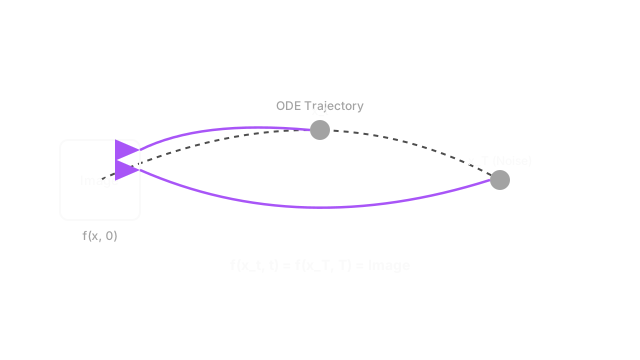
Instead of walking step-by-step from noise to an image, a consistency model learns a mathematical shortcut that allows it to instantly teleport from any point on the noise trajectory directly to the final image.
Why Does This Exist?
The core problem with diffusion models (like DDPMs) is the slow, iterative generation process. To get from pure noise to a clean image, you have to run the neural network tens or hundreds of times. While techniques like Rectified Flow attempt to straighten the path so you can take fewer steps, OpenAI researchers proposed a radically different solution: Consistency Models.
Instead of trying to walk down the path faster, what if you forced the neural network to memorize the final destination of every possible path? If the network knows exactly where the path ends the moment you place it on the starting line, you can generate an image in a single step, bypassing the entire journey. Consistency Models enable real-time, 1-step image generation while maintaining high quality, and they can even be trained without needing a pre-trained diffusion model at all.
Think of It Like This
The Maze Runners
Imagine you are in a massive maze, trying to find the exit (the clean image).
- Diffusion Models: You have a compass (the neural network) that points you in the right direction. You have to take a step, check the compass, take another step, check the compass, and repeat this 100 times until you reach the exit.
- Consistency Models: You have a magical map. No matter where you are dropped in the maze—whether right at the entrance or halfway through—the map instantly shows you the exact GPS coordinates of the exit. You don't walk through the maze; you just teleport directly to those coordinates.
How It Actually Works
The math behind Consistency Models relies on the Probability Flow Ordinary Differential Equation (PF-ODE) established in Score-Based Generative Models. Every data point has a unique, deterministic trajectory tracing it out to pure noise .
1. The Consistency Property
Let be a point on that trajectory at time . The "Consistency Property" states a very simple rule: a function is a consistency function if evaluating it at any point along the trajectory yields the exact same origin point . Mathematically: for all . If is pure noise, then . This means evaluating the function once at instantly yields the clean image.
2. Training via Distillation (The Easy Way)
The most common way to train a Consistency Model is by "distilling" a pre-trained diffusion model. You take a pre-trained model and use it to simulate a small step along the trajectory, from to . You then train the Consistency Model so that its prediction for perfectly matches its prediction for . By enforcing this "consistency" across adjacent steps, the model eventually learns that every point on the entire trajectory must map to the exact same final image.
3. Training in Isolation (The Hard Way)
Unlike Rectified Flow, which strictly requires a pre-trained model to generate the "Reflow" dataset, Consistency Models can actually be trained from scratch without a teacher model. This is called Continuous-Time Consistency Training (CTCT). It uses advanced mathematical bounds to enforce the consistency property directly on the training data. While harder to stabilize, this allows for the creation of blazing-fast 1-step generative models without the massive computational overhead of training a traditional diffusion model first.
4. Multi-Step Generation for Higher Quality
While the entire point of a Consistency Model is 1-step generation, you can actually run it for 2 or 3 steps to get even better images. You take a 1-step jump to the image, inject a tiny amount of noise to step slightly backward, and then take another jump to the image. This gives the network a chance to refine the details, offering a perfect trade-off between speed and quality.
Code
This pseudocode demonstrates the core training objective when distilling a Consistency Model from a pre-trained diffusion model.
import torch
def consistency_distillation_loss(student_model, teacher_model, x_0): """ Computes the loss to enforce the consistency property between adjacent timesteps. """ # 1. Sample a random time t t = sample_random_timestep() # 2. Add noise to the image to get x_{t} and x_{t+1} # (Assuming a small, fixed time step 'dt') x_t = add_noise(x_0, t) x_next = add_noise(x_0, t + dt) # 3. Use the Teacher (pre-trained diffusion model) to take a tiny step # backwards from x_{t+1} to approximate x_t with torch.no_grad(): x_t_approx = teacher_model.denoise_step(x_next, t + dt) # 4. Enforce the Consistency Property! # The student model must predict the EXACT SAME final image (x_0) # regardless of whether it starts at x_{t+1} or the teacher's x_t pred_from_t_next = student_model(x_next, t + dt) pred_from_t = student_model(x_t_approx, t) # 5. The loss is the difference between these two predictions loss = torch.nn.functional.mse_loss(pred_from_t_next, pred_from_t) return lossWatch Out For
The EMA Target Network
In practice, if you just enforce on the exact same neural network, the network can collapse and predict a blank image for everything (since is technically perfectly consistent). To prevent this, Consistency Models use a "Target Network" (an Exponential Moving Average of the student's weights) to evaluate , much like Deep Q-Learning in Reinforcement Learning.
The Quick Version
- Standard diffusion requires many iterative steps to traverse the path from noise to an image.
- Consistency Models learn a mathematical shortcut: they are trained so that any point on a noise trajectory maps directly to the exact starting image.
- Because they know the final destination immediately, they can generate high-quality images in a single step.
- They are typically trained by "distilling" a pre-trained diffusion model, forcing the student network to produce consistent outputs across adjacent time steps.
- Unlike other distillation techniques, they can also be trained completely from scratch without a teacher model.