Continual and Lifelong Learning
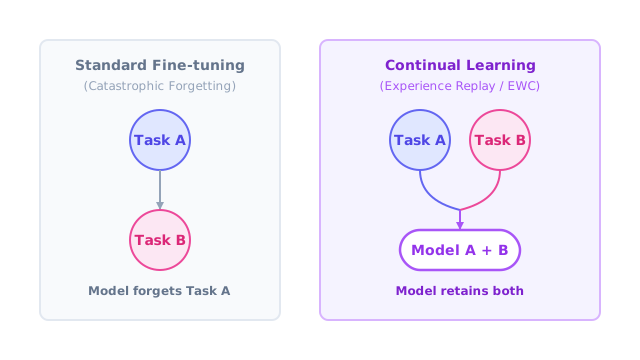
Humans learn continuously; if you learn to ride a bike today, you don't instantly forget how to walk. AI, however, usually suffers from 'catastrophic forgetting'—learning task B completely overwrites its knowledge of task A.
Why Does This Exist?
Standard machine learning models are trained in a static paradigm: collect a massive dataset, train the model until convergence, and deploy it. If the world changes (e.g., a new programming language is invented, or a new CEO takes over a company), the model's knowledge is instantly outdated.
To update the model, you usually have to retrain it from scratch on a mix of the old and new data, which costs millions of dollars in compute. If you try to just fine-tune the model on only the new data, the model will suffer from Catastrophic Forgetting. The gradient updates for the new data will overwrite the weights that were storing the old data. Continual Learning (also called Lifelong Learning) is the research field dedicated to making AI systems that can learn sequentially, adapting to new information in real-time without forgetting the past.
Think of It Like This
Imagine a neural network is a piece of clay.
When you train it on Task A (identifying cats), you mold the clay into a cat shape.
If you want the network to also learn Task B (identifying dogs), you apply new forces to the clay. Because it's the exact same piece of clay, molding it into a dog shape inevitably destroys the cat shape. This is catastrophic forgetting. Continual learning is the search for a way to add new "dog" clay without ruining the "cat" clay, much like how a human brain forms new synapses without destroying the old ones.
How It Actually Works
Researchers use several strategies to mitigate catastrophic forgetting and enable continual learning:
1. Regularization-based Methods
These methods modify the loss function to prevent the model from drastically changing weights that are important for previous tasks.
- Elastic Weight Consolidation (EWC): After training on Task A, the algorithm calculates which specific neural weights were most crucial for Task A. When training on Task B, it applies a heavy penalty (like a rubber band) to those specific weights to prevent them from changing too much, forcing the network to use other, less important weights to learn Task B.
2. Replay (or Rehearsal) Methods
This is the most effective and common method used in industry today.
- Experience Replay: You keep a small memory buffer of data from Task A. When training on Task B, you mix in a small amount of Task A data. By constantly rehearsing the past, the model maintains its old knowledge while learning the new.
- Generative Replay: Instead of storing actual old data (which might violate privacy laws), you train a separate generative AI to generate synthetic "dreams" of Task A data. When training on Task B, the generative model outputs these dreams alongside the real Task B data.
3. Architecture-based Methods
These methods physically change the network structure to accommodate new tasks.
- Progressive Neural Networks: When a new task arrives, the network freezes its existing layers and physically adds new, parallel columns of neurons to learn the new task. It guarantees no forgetting, but the network grows endlessly larger with every new task.
Code
This conceptual code demonstrates how Experience Replay prevents catastrophic forgetting.
class ContinualLearner: def __init__(self, model): self.model = model self.memory_buffer = [] # Stores a small subset of old data def train_on_new_task(self, new_data, memory_batch_size): for new_batch in new_data: # 1. Standard training on the new task loss = compute_loss(self.model, new_batch) # 2. Replay: Mix in data from the memory buffer if len(self.memory_buffer) > 0: old_batch = sample(self.memory_buffer, memory_batch_size) replay_loss = compute_loss(self.model, old_batch) # Combine losses so the model optimizes for both loss = loss + replay_loss loss.backward() optimizer.step() # 3. Update the memory buffer with a sample of the new task for the future self.memory_buffer.extend(sample(new_data, memory_batch_size))Watch Out For
The Stability-Plasticity Dilemma
Continual learning is a fundamental trade-off. If a model is too "stable," it remembers the past perfectly but refuses to learn new things. If it is too "plastic," it learns new things quickly but instantly forgets the past. Tuning this balance is incredibly difficult.
Negative Transfer
Sometimes, forcing a model to remember Task A actively makes it worse at learning Task B, because the underlying rules of the tasks conflict. If Task A was "Drive on the right side of the road" and Task B is "Drive in the UK", trying to merge these skills will result in catastrophic failure.
The Quick Version
- Standard AI models suffer from Catastrophic Forgetting; fine-tuning them on new data destroys their performance on old data.
- Continual Learning aims to solve this, allowing models to learn sequentially like humans do.
- Techniques include Elastic Weight Consolidation (locking important weights), Experience Replay (mixing old data with new data), and Architecture expansion.
- The fundamental challenge of the field is the Stability-Plasticity dilemma: balancing the ability to remember the past with the flexibility to learn the future.