Embedding Fine-Tuning
Off-the-shelf embedding models fail on domain-specific vocabulary. Fine-tuning adjusts the model's weights so that documents and queries in your specific niche map closer together.
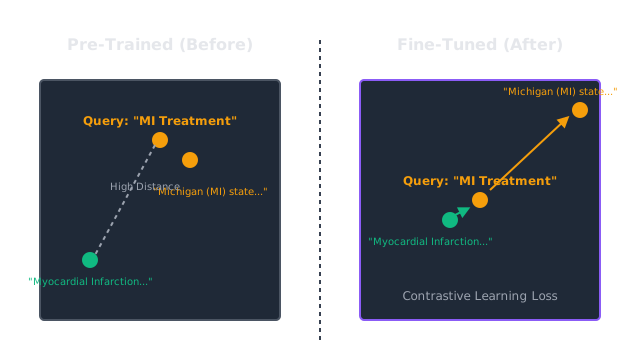
Why Does This Exist?
When you download a pre-trained embedding model from Hugging Face (like all-MiniLM-L6-v2 or OpenAI's text-embedding-3-small), it has been trained on massive, generalized web datasets. It is excellent at understanding everyday language, recognizing that "happy" is close to "joyful," and "car" is close to "automobile."
However, if you deploy this model in a specialized domain—like a hospital, a law firm, or a niche engineering company—it will struggle. To an off-the-shelf model, the medical acronym "MI" might just be letters, rather than "Myocardial Infarction." If a user searches for "heart attack," the pre-trained model won't know to retrieve the "MI" document.
Embedding Fine-Tuning is the process of taking a pre-trained embedding model and training it further on your specific, proprietary dataset. By teaching the model the unique vocabulary and semantic relationships of your domain, you can drastically improve the recall and precision of your semantic search or RAG pipeline.
Think of It Like This
A bilingual dictionary for technical jargon
Imagine you hire a brilliant, highly educated translator (the pre-trained model) who speaks perfect English. You ask them to translate a standard novel, and they do it flawlessly.
Then, you ask them to translate a highly technical quantum physics textbook. They fail, because the words "flavor," "color," and "spin" mean entirely different things in quantum physics than they do in everyday English. The translator doesn't need to relearn English from scratch; they just need a specialized dictionary for physics terms.
Fine-tuning an embedding model is like sending that translator to a crash course in quantum physics. You take a model that already understands the fundamental structure of language and teach it the specific semantic mappings of your domain jargon.
How It Actually Works
The Data Format: Pairs and Triplets
Unlike LLM fine-tuning, which often just requires raw text to predict the next word, embedding fine-tuning usually requires structured data showing relationships.
The two most common formats are:
- Positive Pairs: A dataset of
(Query, Relevant Document)pairs. For example,("How to reset password?", "Navigate to settings > security and click reset."). - Triplets: A dataset of
(Query, Positive Document, Negative Document). This is even better, as it explicitly teaches the model what not to retrieve. You provide a query, a document that answers it, and a "hard negative" document that looks similar but is actually irrelevant.
Contrastive Learning
Embedding fine-tuning almost always relies on Contrastive Learning. The goal is simple: pull the vectors of positive pairs closer together in the high-dimensional space, and push the vectors of negative pairs further apart.
When you feed a batch of queries and documents into the model, the loss function (the mathematical formula the model uses to correct itself) calculates the distance between the vectors.
Common Loss Functions
- Multiple Negatives Ranking Loss (MNRL): This is the most popular loss function for positive-pair datasets. You give it a batch of
(Query, Positive)pairs. For any given query in the batch, its corresponding document is the positive, and all other documents in the same batch are treated as negatives. The model learns to pull the query toward its true document and push it away from the rest. - Triplet Loss / Margin MSE: Used when you explicitly provide hard negatives. The model ensures that the distance between the query and the positive document is smaller than the distance to the negative document by a specific "margin".
Parameter-Efficient Fine-Tuning (PEFT)
Historically, fine-tuning an embedding model meant updating all of its weights (Full Fine-Tuning). Today, techniques like LoRA (Low-Rank Adaptation) are often used. LoRA freezes the original model weights and only trains a tiny set of adapter matrices. This makes fine-tuning much faster, requires drastically less VRAM, and prevents the model from "catastrophically forgetting" its general language capabilities.
Code
Using the sentence-transformers library, fine-tuning an embedding model with Multiple Negatives Ranking Loss requires only a few lines of code.
from sentence_transformers import SentenceTransformer, InputExample, lossesfrom torch.utils.data import DataLoader
# 1. Load a pre-trained, generalized modelmodel = SentenceTransformer('all-MiniLM-L6-v2')
# 2. Prepare domain-specific training data (Positive Pairs)# In reality, this would be loaded from a large JSON/CSV filetrain_examples = [ InputExample(texts=["MI treatment protocol", "Administer aspirin for Myocardial Infarction."]), InputExample(texts=["Hypertension causes", "High blood pressure is linked to high sodium intake."]), InputExample(texts=["Cost of x-ray", "Radiology department billing codes and pricing."])]
# 3. Create a DataLoader to handle batching# Batch size is critical for MNRL; larger batches mean more in-batch negativestrain_dataloader = DataLoader(train_examples, shuffle=True, batch_size=16)
# 4. Define the contrastive loss function# MNRL uses the other examples in the batch as negative examplestrain_loss = losses.MultipleNegativesRankingLoss(model=model)
# 5. Fine-tune the model# We train for just a few epochs so we don't overfitmodel.fit( train_objectives=[(train_dataloader, train_loss)], epochs=3, warmup_steps=10)
# 6. Save the domain-adapted modelmodel.save('./domain-adapted-minilm')
# Now, the model knows that "MI" and "Myocardial Infarction" belong close together!Watch Out For
Catastrophic Forgetting
If you fine-tune an embedding model on a very small, narrow dataset for too many epochs, it will overfit. It might perfectly learn your specific acronyms, but it will "forget" how to process general English words, causing overall search performance to plummet. Always evaluate the fine-tuned model on a hold-out test set, and consider mixing some general-purpose data into your training set to act as an anchor.
Hard negatives are hard to mine
Providing "hard negatives" (documents that look highly relevant to a query but actually aren't) dramatically improves the quality of the fine-tuned embeddings. However, finding these hard negatives is incredibly difficult. You usually have to use a BM25 index to find documents that share exact keywords with the query but don't actually answer it, which requires a complex, multi-stage data preparation pipeline.
The Quick Version
- Pre-trained embedding models fail on specialized jargon and domain-specific terminology.
- Fine-tuning adapts the model's weights to your specific vocabulary, drastically improving semantic search recall.
- It relies on Contrastive Learning: pulling positive
(Query, Document)pairs closer together in vector space while pushing negative pairs apart. - Multiple Negatives Ranking Loss (MNRL) is the most popular training method, as it allows you to train using only positive pairs by treating other documents in the batch as negatives.