Embodied AI
Intelligence isn't just a brain in a jar. Embodied AI is the idea that true artificial intelligence requires a physical or virtual body that can interact with the environment, experience physics, and learn from its own actions.
Why Does This Exist?
Large Language Models can write poetry, ace the Bar exam, and write complex software. But if you ask an LLM to fold a laundry shirt or open a door, it fails completely. This disparity is known as Moravec's Paradox: high-level reasoning is computationally easy, but low-level sensorimotor skills—which evolution spent hundreds of millions of years perfecting—are incredibly difficult.
Embodied AI exists to solve this paradox. It argues that you cannot reach Artificial General Intelligence (AGI) just by scaling up text prediction. An AI must have a "body" (whether a physical robot or a virtual avatar in a simulation) so it can ground its knowledge in physical reality. When an AI can drop an object, hear it shatter, and see the pieces, it learns a deeper, causal understanding of the universe than it could ever learn from reading Wikipedia.
Think of It Like This
Imagine trying to teach someone how to ride a bicycle by only having them read books about physics, gyroscopes, and human anatomy.
No matter how many books they read (an LLM's approach), they will fall over the first time they get on the bike. To actually learn, they have to get on the bike, feel the balance, make a mistake, fall over, and adjust their muscles (Embodied AI's approach). The intelligence is learned through the physical interaction.
How It Actually Works
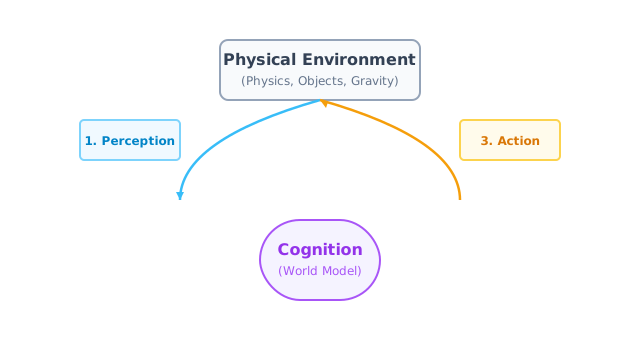
Embodied AI relies on closing the Perception-Action Loop. The agent is not a passive observer; its actions change the environment, which in turn changes what the agent perceives next.
1. Perception (Sensors)
An embodied agent takes in high-bandwidth, multimodal data from its environment. This isn't just text. It includes:
- Vision: RGB cameras, depth sensors (LiDAR/RGB-D).
- Proprioception: Knowing where its own "limbs" are in space (joint angles, motor torque).
- Tactile: Force sensors in robotic grippers to feel if an object is slipping.
2. Cognition (The Brain)
The agent processes these sensory inputs to build a World Model. It must perform Simultaneous Localization and Mapping (SLAM) to know where it is, identify objects, and plan a sequence of actions to achieve a goal (e.g., "Navigate to the kitchen, find the cup, grasp the cup").
3. Action (Actuators)
The agent translates its high-level plan into low-level motor commands (e.g., apply 5 Volts to the elbow motor). As the agent moves, the environment changes, generating new sensory data, and the loop repeats.
The Grounding Problem
Embodied AI solves the "Symbol Grounding Problem." To an LLM, the word "heavy" is just a statistical vector that often appears near "weight." To an Embodied AI that has tried to lift a 50kg box and failed due to motor strain, the word "heavy" has a grounded, physical meaning.
Code
This conceptual loop shows the core difference between a passive LLM and an embodied agent.
class EmbodiedAgent: def __init__(self, body, brain): self.body = body # Sensors (cameras) and Actuators (motors) self.brain = brain # Neural network policy def run_perception_action_loop(self, goal): while not self.brain.is_goal_achieved(goal): # 1. Perception: Agent reads the physical world rgb_image, joint_angles = self.body.read_sensors() # 2. Cognition: Brain processes state and decides what to do # The decision is grounded in physical capability motor_command = self.brain.decide_next_action(rgb_image, joint_angles, goal) # 3. Action: Agent alters the physical world # This action directly causes the next perception self.body.execute(motor_command)
# An LLM loop is just: output = predict_next_token(input)# An Embodied loop is an ongoing interaction with physics.Watch Out For
The Sim-to-Real Gap
Because training robots in the real world is slow and breaks expensive hardware, researchers train embodied agents in fast computer simulations. However, when you copy the trained "brain" into a real physical robot, it often fails because the simulation's physics were not perfectly accurate. This is the notorious Sim-to-Real gap.
Moravec's Paradox
Never underestimate the complexity of simple tasks. Teams often assume that if their AI can write Python code, getting it to fold a towel will be easy. Towel-folding involves infinite degrees of freedom, self-occlusion, and soft-body physics. It is mathematically harder than coding.
The Quick Version
- Embodied AI posits that intelligence requires physical interaction with an environment, not just passive data processing.
- Moravec's Paradox highlights that high-level reasoning is easy for AI, while low-level physical tasks (walking, grasping) are incredibly hard.
- Embodied agents operate on a continuous Perception-Action Loop: sensing the world, planning, acting, and sensing the changes they caused.
- Having a body allows an AI to ground abstract concepts (like "heavy" or "fragile") in physical reality.