Catastrophic Forgetting in Fine-Tuning
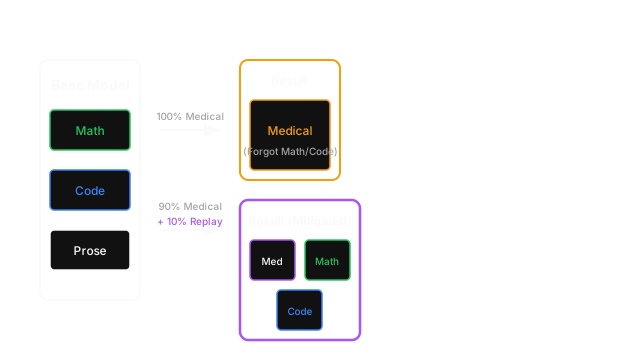
Neural networks have finite capacity. If you pull all the gradients toward a narrow task (like reading legal contracts), the model will literally overwrite the weights it used to perform other tasks (like writing Python). Replay data prevents this.
Why Does This Exist?
You take an excellent general-purpose model like Llama 3, and you want to make it an expert in your company's proprietary SQL schema. You fine-tune it on 50,000 SQL queries. It becomes brilliant at SQL. But when you ask it to summarize an email or translate a sentence into French—things it used to do flawlessly—it outputs garbled text or hallucinates SQL syntax into the response.
The model has suffered from catastrophic forgetting. Neural networks do not have partitioned memory drives. Knowledge is distributed across the weights. When you feed the network nothing but SQL for thousands of steps, the backpropagation algorithm ruthlessly optimizes the weights for SQL, overwriting the connections that used to represent French grammar or email summarization.
Think of It Like This
Muscle memory and the golf swing
Imagine a world-class decathlete who suddenly decides to train exclusively for golf, practicing nothing but their golf swing for a year. Their golf swing will become perfect. But if you suddenly ask them to throw a javelin or run a hurdle race, they will struggle, because their muscle memory has entirely adapted to the biomechanics of golf.
To maintain their decathlon skills, they can't just play golf. They must periodically replay the javelin throw and the hurdles alongside their golf training.
How It Actually Works
The Mechanism of Forgetting
During Supervised Fine-Tuning (SFT) or continued pretraining, the loss function calculates how wrong the model is on the current batch of data. If the current batch contains 100% legal text, the gradients point in whatever direction minimizes legal text prediction error. The optimizer does not care if those specific weight updates destroy the model's ability to write code; it only cares about the current loss landscape.
Full fine-tuning is highly susceptible to this because every weight is unfrozen. Parameter-Efficient Fine-Tuning (PEFT, like LoRA) is naturally more resistant to catastrophic forgetting because the vast majority of the "general knowledge" weights remain frozen, and the model is forced to route the new knowledge through the adapter bottlenecks.
The Solution: Replay Data
The standard engineering solution to catastrophic forgetting is Data Replay (or data mixing).
Instead of training on a dataset of 100% SQL, you train on a dataset of 90% SQL and 10% "General Capabilities" (a random sample of coding, writing, and math tasks from the original instruction-tuning distribution).
By ensuring the model continues to see the general tasks in every batch, the loss function is forced to find a compromise: update the weights to learn SQL, but only in ways that do not increase the error on the general tasks. This anchors the original knowledge while accommodating the new domain.
Watch Out For
Over-tuning to a specific format
Forgetting isn't just about facts; it's about formats. If your entire fine-tuning dataset ends every response with "Let me know if you need anything else!", the model will overwrite its natural stopping behavior. Even if you ask it to output raw JSON, it will append that sentence to the end of the JSON, breaking your parsers.
The Quick Version
- Catastrophic forgetting occurs when a neural network overwrites previous knowledge to optimize for a new, narrow dataset.
- Full fine-tuning causes extreme forgetting; LoRA and PEFT methods reduce it by freezing the base weights.
- The primary mitigation is Replay: mixing a small percentage (e.g., 5-10%) of general, high-quality data into the narrow fine-tuning dataset to anchor existing capabilities.