Hardware-Software Co-Design
You can't build a Formula 1 race car by putting a jet engine into a minivan. To get maximum performance, the engine (software) and the chassis (hardware) must be designed together.
Why Does This Exist?
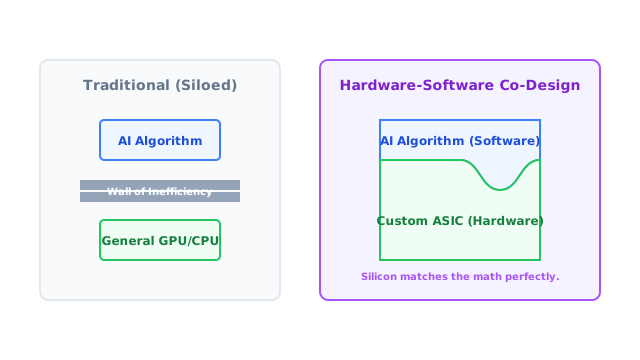
In traditional computer science, software and hardware are completely separate. Intel builds a general-purpose CPU, and thousands of developers write software that happens to run on it.
In modern AI, this separation is a fatal bottleneck. We have realized that the math required for Deep Learning (Matrix Multiplication) is very specific. If you try to run AI algorithms on general-purpose hardware, 90% of the silicon is wasted on features the AI doesn't need (like complex branching logic or display drivers), and it consumes too much energy.
Hardware-Software Co-Design is the philosophy of building the algorithm and the physical silicon chip at the exact same time. The AI researchers tell the chip designers exactly what math operations they need, and the chip designers tell the AI researchers exactly how much memory bandwidth is physically possible. They compromise and design a unified system.
Think of It Like This
Traditional Design (Software first, hardware later): You write a recipe for a 10-course meal. You hand it to a chef who works in a tiny apartment kitchen. The chef struggles, drops plates, and takes 6 hours to cook it.
Co-Design: You want to serve a 10-course meal. You and the architect design a custom commercial kitchen specifically for your exact recipe. You put the oven exactly one step away from the prep station. The meal takes 30 minutes to cook.
How It Actually Works
The dominance of the Transformer architecture has accelerated co-design, because the industry knows exactly what math needs to be optimized.
1. The Memory Wall
The biggest problem in AI isn't doing the math; it's moving the data. A GPU spends most of its time and energy just moving numbers from RAM into the computation core and back out again. This is called the "Memory Wall." Co-design solves this. For example, Google designed the TPU (Tensor Processing Unit) to have massive, high-speed interconnects specifically optimized for the exact shape of the matrices used in their internal neural networks.
2. Custom Silicon (ASICs)
An ASIC (Application-Specific Integrated Circuit) is a chip that can do exactly one thing, but does it perfectly.
- Groq: A startup that designed an LPU (Language Processing Unit). They looked at the autoregressive nature of LLMs (generating one word at a time) and designed a chip with no external memory delays, allowing it to generate text an order of magnitude faster than a standard GPU.
- Etched: Another startup designing chips that are literally hard-coded to run the Transformer algorithm. If the AI industry shifts away from Transformers, the chip becomes a useless paperweight, but as long as Transformers rule, it is devastatingly fast and cheap.
3. The "Hardware Lottery"
Researchers often point out that the neural network architectures we use today (like Transformers) might not actually be the best possible AI algorithms. They just happen to be the algorithms that run best on Nvidia GPUs. If we had designed different hardware 15 years ago, we might be using completely different AI math today. This dependency is known as the "Hardware Lottery."
Code
You cannot "code" hardware in Python, but chip designers use hardware description languages (like Verilog) to literally program the physical silicon gates to match the AI researcher's math.
// A conceptual snippet of Hardware Description Language (Verilog)// This code doesn't compile to an executable; it compiles into a blueprint// for physically wiring silicon transistors together to do matrix math.
module MatrixMultiplier( input [31:0] activation_A, input [31:0] weight_B, output [31:0] result); // Hard-wire a multiplier circuit directly into the silicon // This is infinitely faster than asking a general-purpose CPU // to load a software-based multiplication function. assign result = activation_A * weight_B; endmoduleWatch Out For
The Lock-in Risk
If you spend $100 Million designing and printing a custom ASIC chip that perfectly runs a Transformer, and researchers invent a totally new, better architecture (like Mamba or State Space Models) six months later, your custom chips are instantly obsolete. Co-design requires betting heavily on a specific algorithmic future.
Supply Chain Vulnerability
Designing the chip is only half the battle. Actually manufacturing it requires extreme ultraviolet lithography (EUV) machines, primarily built by one company (ASML) and printed in a handful of fabs (like TSMC). Co-design inextricably links AI software progress to geopolitical hardware supply chains.
The Quick Version
- Traditional computer science separates software development from hardware engineering.
- Hardware-Software Co-Design treats them as a single problem. The AI algorithm and the silicon chip are designed together to eliminate bottlenecks (like memory transfer delays).
- This has led to the rise of custom AI chips (TPUs, LPUs) that are exponentially faster and more energy-efficient than general-purpose CPUs or GPUs.
- It carries the risk of "Hardware Lottery" lock-in: if the fundamental AI math changes, the custom hardware becomes instantly obsolete.