Metadata Filtering
Vector databases search by semantic meaning, but sometimes you just want exact constraints (like 'only documents from 2024'). Metadata filtering combines the fuzziness of AI search with the precision of SQL.
Why Does This Exist?
Vector similarity search is incredible at finding concepts that mean the same thing, but it is terrible at respecting exact factual boundaries.
Imagine a user asks a company chatbot: "What were our total sales in Q3 2024?"
If you embed this query and search the vector database, the database will return documents that talk about "Q3 sales" and "revenue." But because the database only calculates mathematical distance based on word meanings, it is highly likely to return the Q3 sales report for 2023 or 2022. The text in those older reports is almost identical to the 2024 report (same authors, same formatting, same vocabulary), so they land right next to each other in the vector space.
If the LLM reads the 2023 report, it will confidently answer the user with the wrong data.
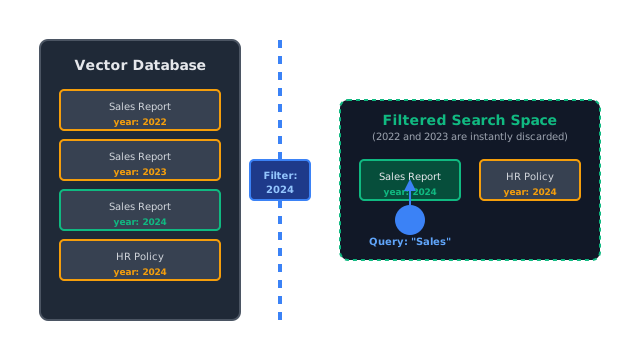
Metadata Filtering solves this. It allows you to attach standard JSON tags (metadata) to every vector. During a search, you can apply SQL-like constraints (e.g., WHERE year == 2024) before the vector search even runs.
Think of It Like This
Searching a library by genre
Standard Vector Search: You walk into a massive library and ask the librarian for "a book about a wizard going to school." The librarian uses semantic search across all books and returns Harry Potter, but also a non-fiction historical book about occult practices in medieval universities.
Metadata Filtering: You tell the librarian, "I want a book about a wizard going to school, WHERE genre == 'Fiction' AND WHERE target_audience == 'Children'." The librarian instantly ignores the non-fiction wing of the library, and only does the semantic search within the children's fiction section.
How It Actually Works
Implementing metadata filtering requires changes during both ingestion and retrieval.
1. Tagging during Ingestion
When you chunk your documents and send them to the embedding model, you don't just store the vector. You store the vector alongside a JSON payload containing facts about the document.
{ "id": "chunk_841", "vector": [0.12, -0.45, 0.88, ...], "text": "Total Q3 sales reached $45M.", "metadata": { "year": 2024, "quarter": "Q3", "department": "sales", "clearance_level": "public" }}2. Filtering during Retrieval
When a user submits a query, you pass a filter object to the vector database along with the query vector.
There are two ways databases handle this under the hood:
- Pre-filtering (The Standard): The database looks at the metadata filter (
year == 2024), instantly discards all 2023 vectors from the search space, and then calculates the vector distances on the remaining vectors. This is fast and accurate. - Post-filtering (The Danger Zone): Older databases used to do the vector search first, grab the top 10 results, and then throw away the ones that didn't match the metadata. If all top 10 results were from 2023, the database would return 0 results, even if a perfect 2024 document was sitting at rank 11. Modern databases (like Pinecone, Qdrant, and Milvus) use Single-Stage Filtering to avoid this.
3. Role-Based Access Control (RBAC)
The most critical use case for metadata filtering in Production RAG is security. You tag every vector with a clearance_level. When an intern queries the database, the backend hardcodes a filter WHERE clearance_level == 'public'. When the CEO queries the database, the filter is WHERE clearance_level IN ['public', 'confidential']. This ensures the intern physically cannot retrieve the CEO's salary data.
Code
Most vector databases use a MongoDB-like syntax for metadata filtering. Here is an example using the official Pinecone Python SDK.
from pinecone import Pinecone
# Initialize DBpc = Pinecone(api_key="YOUR_API_KEY")index = pc.Index("corporate-knowledge")
# The user's queryuser_query = "What were our total sales?"query_vector = embed_text(user_query) # Assume this function exists
# 1. Standard Search (Bad: Might return 2022 data)standard_response = index.query( vector=query_vector, top_k=3, include_metadata=True)
# 2. Filtered Search (Good: Forces the DB to only look at Q3 2024)# Notice the MongoDB-style dictionary syntaxfiltered_response = index.query( vector=query_vector, filter={ "year": {"$eq": 2024}, "quarter": {"$eq": "Q3"}, "department": {"$in": ["sales", "finance"]} }, top_k=3, include_metadata=True)
print("Standard Results:")for match in standard_response['matches']: print(f"- {match['metadata']['year']} {match['metadata']['quarter']} Report")
print("\nFiltered Results:")for match in filtered_response['matches']: print(f"- {match['metadata']['year']} {match['metadata']['quarter']} Report")
# -> Standard Results:# -> - 2022 Q3 Report# -> - 2023 Q3 Report# -> - 2024 Q3 Report## -> Filtered Results:# -> - 2024 Q3 ReportWatch Out For
Self-Querying LLMs
If a user types "What were sales in 2024?", how does the Python code know to set the filter to year == 2024? You cannot expect end-users to write JSON filters.
To solve this, advanced pipelines use a "Self-Querying Retriever." The user's raw text is sent to a fast LLM (like GPT-4o-mini). The LLM is prompted to extract any explicit metadata constraints (like years, departments, or document types) and output the JSON filter object before the vector search occurs.
The Quick Version
- Vector search groups documents by meaning, which causes it to fail when users need exact factual constraints (like specific dates or departments).
- Metadata filtering allows you to attach JSON tags (year, author, clearance level) to every vector during ingestion.
- During retrieval, the database acts like a standard SQL database, filtering out vectors that don't match the constraints before running the semantic search.
- It is the absolute core mechanism for implementing security and access control (RBAC) in enterprise RAG systems.