Program Synthesis
Instead of writing code line-by-line, what if you could just describe what you want a program to do, and the AI writes the entire source code for you?
Why Does This Exist?
Writing software is inherently difficult. Humans have to translate abstract business requirements (e.g., "Sort this list of users by age, but put VIPs first") into rigid, mathematically precise syntax (e.g., users.sort(key=lambda x: (not x.is_vip, x.age))).
Program Synthesis is the holy grail of computer science: automating that translation. If an AI can reliably write code from natural language, it fundamentally changes what it means to be a programmer. You stop being a "coder" who types syntax, and you become a "specifier" who defines intent and reviews AI-generated logic. Modern LLMs (like GitHub Copilot or Claude) are the first systems to make this viable at scale.
Think of It Like This
Imagine you want a custom house built.
Traditional Programming: You have to buy the lumber, cut the wood, nail the frame together, and wire the electricity yourself.
Program Synthesis: You hire a master architect and an autonomous construction crew. You just say, "I want a 3-bedroom house with a red door and a south-facing window." The AI draws the blueprints and builds the house. You just have to inspect it to make sure they didn't put the bathroom in the kitchen.
How It Actually Works
Modern Program Synthesis via LLMs relies on several key mechanisms:
1. Code as a Language
Programming languages (Python, C++) are highly structured. Because they follow strict grammar rules and are highly repetitive, Transformers are actually better at learning to write code than they are at writing English. LLMs are trained on massive repositories of open-source code (like GitHub), learning the statistical relationships between variable names, function signatures, and comments.
2. Execution as Feedback
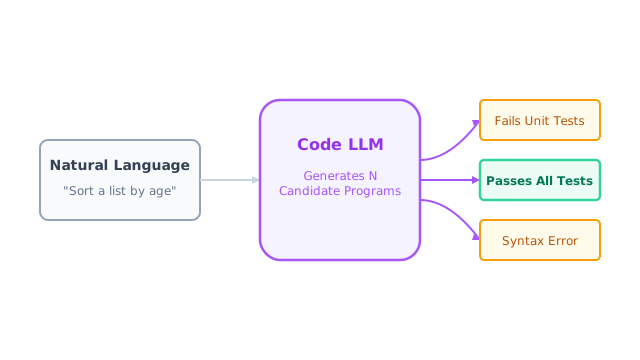
The biggest advantage of synthesizing code (as opposed to synthesizing poems) is that code is verifiable. If an AI writes a poem, it's hard to mathematically prove it is a "good" poem. If an AI writes a sorting algorithm, you can run it against 100 unit tests. If it passes, the code works.
Systems like DeepMind's AlphaCode use this to their advantage. They generate 1,000 different possible programs for a single prompt, run all of them through a compiler and a set of hidden unit tests, and only present the single program that passes all the tests to the user.
3. Formal Verification
In high-stakes environments (like writing code for an airplane), passing unit tests isn't enough. Researchers use Formal Verification, which mathematically proves that the generated code will never violate a specific rule, regardless of the input. Synthesis models are now being trained to generate the code and the mathematical proof simultaneously.
Code
This snippet demonstrates a basic synthesize-and-test loop.
def synthesize_and_verify(prompt, test_cases, llm): """ Generate multiple programs and filter out the ones that fail tests. """ # Ask the LLM to generate 10 different attempts at the code candidate_programs = llm.generate_code(prompt, num_candidates=10) for program in candidate_programs: passes_all_tests = True for (input_data, expected_output) in test_cases: try: # DANGEROUS: Sandboxing required in real life actual_output = execute_code(program, input_data) if actual_output != expected_output: passes_all_tests = False break except Exception: passes_all_tests = False break if passes_all_tests: return program # Found a working solution! return "Synthesis failed. No generated program passed the tests."Watch Out For
The Specification Bottleneck
As the AI gets better at writing code, the bottleneck shifts to the human. If you ask an AI to "build a banking app," the AI will write code, but it will probably be the wrong banking app, because your prompt was too vague. Writing a perfect prompt that specifies every edge case is often just as hard as writing the code yourself.
Subtle Hallucinations
An AI might synthesize 50 lines of code that looks perfect, compiles correctly, and runs without errors, but contains a subtle logical flaw (e.g., using <= instead of < on an array boundary). Because the code looks so professional, humans tend to trust it blindly, leading to catastrophic production bugs.
The Quick Version
- Program Synthesis is the automated generation of executable code from high-level specifications (usually natural language).
- Modern synthesis is driven by LLMs trained on millions of open-source code repositories.
- Code is unique because it can be automatically verified. AI can generate hundreds of solutions and use a compiler/unit tests to filter out the hallucinations.
- It shifts the role of software engineers from "writing syntax" to "defining specifications and reviewing logic."