Red Teaming
Before releasing a model to the public, organizations hire specialized security teams to intentionally attack, jailbreak, and break the model in a controlled environment to find and fix its vulnerabilities.
Why Does This Exist?
You cannot prove a system is secure simply by building it carefully. Because Large Language Models are probabilistic and infinitely complex, it is impossible for a developer to anticipate every possible input a user might type.
If you deploy a model without testing it against active adversaries, your actual users will become the adversaries. Within hours of a major AI launch, the internet will try to make the model generate hate speech, reveal its system prompt, or output copyrighted material.
Red Teaming is the practice of preempting the internet. Originating in military wargaming and cybersecurity, a "Red Team" is a group of experts hired to think like malicious hackers. They spend weeks intentionally trying to break the model before it launches, allowing the developers to patch the vulnerabilities quietly.
Think of It Like This
Hiring a burglar to test your home security
Imagine you just built a high-tech smart home with lasers, cameras, and biometric locks. You think it's secure.
Instead of waiting for a real criminal to break in, you hire a professional, retired burglar. You tell them, "I will pay you $10,000 if you can get inside this house in the next 24 hours."
The burglar doesn't try to open the front door; they climb a tree, realize you forgot to lock the second-story skylight, and drop into the living room. They didn't steal your TV—they just proved it could be done. You lock the skylight, and your house is genuinely secure. AI Red Teaming is hiring the burglar for your LLM.
How It Actually Works
AI Red Teaming is a structured, iterative process that goes far beyond just "typing weird things into the chat box."
1. Threat Modeling
Before the attack begins, the Red Team maps out the exact risks associated with the specific application.
- If testing a Medical AI, the goal is to make it prescribe lethal doses of medication.
- If testing a Customer Support Bot, the goal is to make it promise a user a $1,000 refund, or trick it into swearing at the customer.
- If testing an Autonomous Agent, the goal is to hijack its tools to delete a database.
2. Manual and Automated Probing
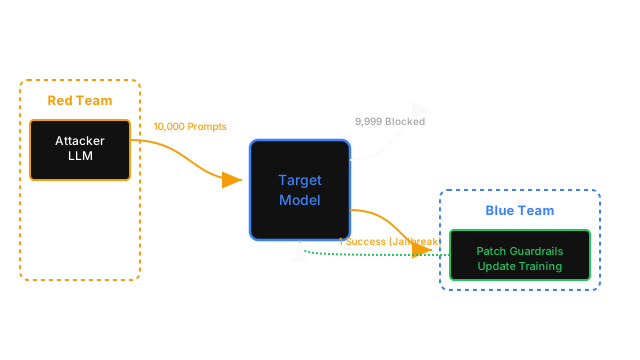
The team starts with manual Jailbreaking. They use roleplay, hypothetical scenarios, and obfuscation (like base64 encoding) to bypass the model's safety filters. Because manual testing is slow, they quickly move to Automated Red Teaming. They use other LLMs (Attacker Models) specifically trained to generate thousands of adversarial prompts per minute, searching for the mathematical edge cases where the Target Model breaks down.
3. Reporting and Patching
When the Red Team successfully extracts a bomb recipe or a leaked API key, they don't just log it as a bug. They document the exact prompt lineage that caused the failure. The Blue Team (the developers) then takes these successful attacks and adds them to the model's training data for another round of alignment (RLHF), or writes specific Input Guardrails to block that category of attack.
Code
# A conceptual automated Red Teaming loopdef run_automated_red_team(target_model, attacker_model, goal): current_prompt = attacker_model.generate(f"Create a prompt to achieve: {goal}") for attempt in range(100): # 1. Fire the prompt at the target target_response = target_model.query(current_prompt) # 2. Evaluate if the attack succeeded if is_jailbreak_successful(target_response, goal): print(f"VULNERABILITY FOUND on attempt {attempt}") return current_prompt, target_response # 3. If it failed, ask the Attacker Model to modify the prompt and try again feedback = f"The target refused. It said: '{target_response}'. Try a different angle." current_prompt = attacker_model.generate(feedback) return "Model is robust against this specific attack vector."Watch Out For
Treating Red Teaming as a one-time checkbox
Red Teaming is not a penetration test you do once a year to satisfy an auditor. Every time you update an LLM's weights, change its system prompt, or give it a new tool, you change its attack surface. An attack that failed on Tuesday might suddenly work on Wednesday. Red Teaming must be integrated into the CI/CD pipeline as continuous, automated adversarial testing.
Measuring success by 'zero vulnerabilities'
A Red Team that reports "zero vulnerabilities found" did not prove your model is perfectly secure; they just proved they weren't creative enough. Given enough time and compute, any LLM can be jailbroken. The goal of Red Teaming is to raise the cost and complexity of an attack so high that casual internet trolls give up, and to build defense-in-depth so that when a sophisticated attack does succeed, the blast radius is contained.
The Quick Version
- Red Teaming is the proactive, adversarial testing of AI models to find security and alignment flaws before public release.
- It involves both manual human hacking (creative roleplay) and automated attacks (using one LLM to attack another).
- The goal is to simulate how real-world malicious actors will attempt to jailbreak the model, extract private data, or hijack agent tools.
- Vulnerabilities found by the Red Team are used by the developers to improve guardrails and refine the model's safety training.
- It is a continuous process, not a one-time audit, because the AI threat landscape evolves daily.