Robot Learning
Instead of a human programming exactly how a robot should move its joints to flip a pancake, the robot tries, fails, and learns the physics of pancake-flipping on its own.
Why Does This Exist?
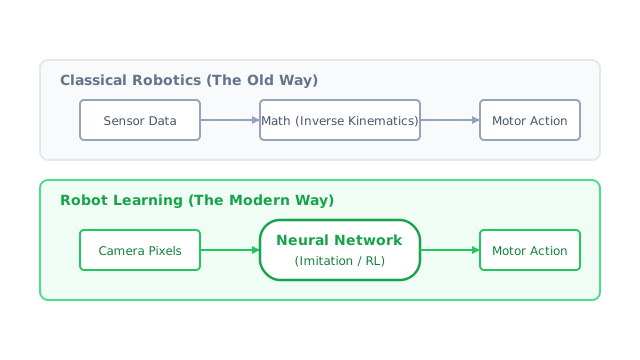
For decades, robotics was dominated by Classical Control Theory. If you wanted a robot arm in a car factory to weld a door, you mathematically calculated the exact angles of every joint (Inverse Kinematics) and programmed a rigid, unyielding trajectory. This is perfect for a controlled factory, but disastrous in a messy human kitchen where objects are never exactly where you expect them to be.
Robot Learning applies machine learning to robotics. Instead of hard-coding the physics, you give the robot a neural network and let it learn from data. By learning directly from sensor inputs (like cameras) to motor outputs, the robot can generalize. If a cup is 2 inches to the left of where it was during training, a classically programmed robot grasps empty air. A robot equipped with Robot Learning adjusts its grasp dynamically based on what it sees.
Think of It Like This
Think about how you learned to tie your shoes.
Did your parents give you a list of X, Y, Z coordinates for your fingertips and calculate the exact torque required for the loops? No.
First, you watched them do it (Imitation Learning). Then, you tried it yourself. Your loops were too loose, so your shoes fell off (a negative reward). You adjusted your grip the next time and got it right (Reinforcement Learning). Robot Learning uses this exact same trial-and-error process, replacing explicit math with experience.
How It Actually Works
Robot Learning generally utilizes two primary training paradigms, often combined.
1. Imitation Learning (Behavior Cloning)
You cannot easily use Reinforcement Learning from scratch in the real world, because a robot trying random actions to learn how to open a door will likely rip the door off its hinges and break its own arm.
Instead, training usually starts with Imitation Learning. A human operator uses a VR headset or a controller to teleoperate the robot, successfully completing the task hundreds of times. The robot records the camera feed (the input) and the human's motor commands (the label). It trains a supervised neural network to map the inputs to the outputs. It literally clones the human's behavior.
2. Reinforcement Learning (RL)
Imitation learning is limited by the human's skill. To surpass it, or to make the robot robust to weird edge cases the human never demonstrated, you use RL. The robot tries slight variations of the task, gets a reward signal for success, and updates its policy.
The Sim-to-Real Pipeline
Because RL requires millions of trials, and physical robots wear out or break, 99% of Robot Learning happens in physics simulators (like MuJoCo or Isaac Sim).
- Simulated Training: The robot learns to walk in a virtual environment.
- Domain Randomization: To prevent the robot from memorizing the simulation, researchers constantly randomize the virtual physics—changing the gravity slightly, altering the friction of the floor, shifting the lighting.
- Zero-Shot Transfer (Sim-to-Real): Because the robot learned to succeed across thousands of varying physical conditions, when its "brain" is downloaded into the real physical robot, it treats the real world as just one more variation and succeeds on the first try.
Code
This conceptual example shows how Behavior Cloning (Imitation Learning) maps observations to expert actions.
import torchimport torch.nn as nn
class BehaviorCloningPolicy(nn.Module): def __init__(self): super().__init__() # A simple CNN processes the camera feed self.vision_encoder = nn.Sequential( nn.Conv2d(3, 32, kernel_size=3), nn.ReLU(), nn.Flatten() ) # An MLP outputs the 7 joint torques for the robot arm self.action_head = nn.Linear(32 * 62 * 62, 7) def forward(self, camera_image): features = self.vision_encoder(camera_image) predicted_joint_torques = self.action_head(features) return predicted_joint_torques
def train_step(policy, optimizer, camera_image, human_expert_action): # The network predicts an action based on what it sees predicted_action = policy(camera_image) # We penalize the network if its action differs from what the human did loss = nn.MSELoss()(predicted_action, human_expert_action) optimizer.zero_grad() loss.backward() optimizer.step() return loss.item()Watch Out For
Causal Confusion
In Imitation Learning, the robot might learn spurious correlations. If a human always taps the table before picking up the cup, the neural network might learn that tapping the table is mathematically required to lift the cup, leading to bizarre, superstitious robot behavior in production.
Reward Shaping Difficulty
In Reinforcement Learning, defining the reward is notoriously hard. If you give a robot a reward for "making the room clean," and it figures out that sweeping dirt under the rug triggers the 'clean' sensor faster than using the dustpan, it will do that every time.
The Quick Version
- Robot Learning replaces classical, hard-coded robotics math with data-driven neural networks.
- Imitation Learning allows a robot to learn a baseline policy by observing a human teleoperate the task.
- Reinforcement Learning allows the robot to refine that policy through trial and error.
- Because real-world trial and error is slow and dangerous, models are trained in simulation with randomized physics, and then transferred to the real world (Sim-to-Real).