Self-Supervised Vision Features
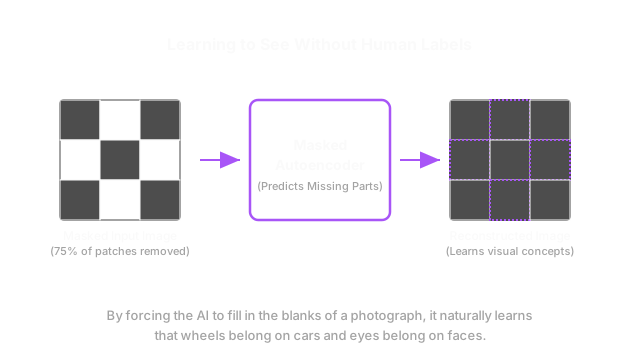
Instead of teaching an AI to recognize a dog by showing it a million pictures labeled 'dog', we can teach it to understand the visual world by removing 75% of an image and forcing it to guess the missing pixels.
Why Does This Exist?
In Natural Language Processing, we achieved massive breakthroughs (like GPT-3) by using Self-Supervised Learning. We didn't hire humans to label text. We just took millions of books, hid a few words on each page, and forced the AI to predict the hidden words. By playing this "fill in the blanks" game, the AI naturally learned grammar, facts, and logic.
For years, Computer Vision lagged behind because it relied on human labels (Supervised Learning) or messy image captions (like CLIP). Researchers realized they needed a way to apply the "fill in the blanks" game to images so Vision Encoders could learn the structure of the physical world directly from the raw pixels, without any human text required.
Think of It Like This
The Jigsaw Puzzle Master
If you want to become a master at jigsaw puzzles, you don't need someone to stand over your shoulder and yell "That is a dog!" every time you finish a puzzle. You just need thousands of boxes of puzzles with 75% of the pieces missing. As you try to guess what the missing pieces look like, your brain naturally learns that wheels usually go under cars, eyes usually come in pairs, and sky is usually above the grass. You learn the rules of reality simply by trying to fill in the missing pieces.
How It Actually Works
The most famous architecture for Self-Supervised Vision is the Masked Autoencoder (MAE), pioneered by Kaiming He (the inventor of ResNet) in 2021.
1. Massive Masking
We take an image and chop it into a grid of patches (e.g., pixels each). Then, we randomly delete 75% of the patches. Most of the image is completely gone.
2. The Encoder
We feed the remaining 25% of the patches into a standard Vision Transformer (ViT). Because it's only processing 25% of the image, the Encoder runs incredibly fast. It outputs a set of dense embeddings representing the visual context of those few surviving patches.
3. The Decoder (Filling in the Blanks)
We take the Encoder's output and insert "empty" mask tokens where the missing patches used to be. We feed this full sequence into a small Decoder network. The Decoder's job is to literally paint the missing pixels. It tries to reconstruct the original image exactly as it was.
4. The Magic of Representation Learning
To successfully rebuild the image from only 25% of the pixels, the network must develop a deep, holistic understanding of objects, textures, and physics. It has to learn that a furry texture implies an animal, or that a shadow implies a light source. Once training is complete, we throw away the Decoder entirely. The remaining Encoder is a phenomenally powerful, generalized vision model that can be plugged into a VLM or fine-tuned for robotics.
Code
This pseudocode shows the incredibly simple training loop of a Masked Autoencoder.
import torchimport torch.nn.functional as F
def train_mae_step(image, mae_model): """ Self-Supervised Training Step for a Masked Autoencoder """ # 1. Chop the image into patches (e.g., 196 patches) patches = patchify(image) # 2. Randomly drop 75% of the patches # visible_patches: The 25% we keep # masked_indices: Where the missing patches go visible_patches, masked_indices = random_masking(patches, mask_ratio=0.75) # 3. Pass only the visible patches through the heavy Encoder encoded_features = mae_model.encoder(visible_patches) # 4. Reconstruct the full image using the small Decoder predicted_patches = mae_model.decoder(encoded_features, masked_indices) # 5. Calculate the Loss (Mean Squared Error) # We only calculate the error on the patches that were hidden! # "How close were your painted pixels to the real hidden pixels?" original_masked_patches = get_masked_patches(patches, masked_indices) loss = F.mse_loss(predicted_patches, original_masked_patches) return lossWatch Out For
Pixels vs. Concepts
Unlike CLIP (which learns high-level text concepts like "golden retriever"), Masked Autoencoders learn low-level pixel structures. If an MAE is reconstructing a dog, it focuses heavily on getting the exact texture of the fur correct, rather than understanding the name of the dog breed. Because of this, Self-Supervised Vision features are incredibly good at dense tasks like medical imaging segmentation or self-driving car depth estimation, but they often require extra fine-tuning to be useful for simple image classification.
The Quick Version
- Computer Vision historically relied on expensive human labels (Supervised) or noisy image captions (CLIP).
- Self-Supervised Learning (SSL) allows Vision models to learn directly from raw images by playing a "fill in the blanks" game.
- In a Masked Autoencoder (MAE), 75% of an image is deleted. The network is forced to predict the exact color of the missing pixels.
- By solving this impossible puzzle millions of times, the AI naturally learns the physical structure of the world, resulting in a highly robust Vision Encoder that can be used for downstream tasks.