Synthetic Data for Post-Training
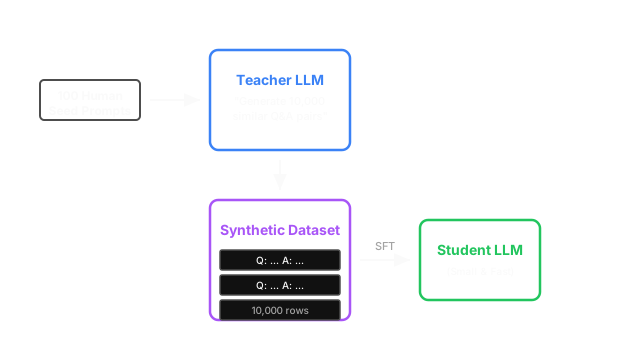
Instead of paying humans to write 10,000 Q&A pairs to fine-tune a small model, you write a clever prompt and ask a massive frontier model like GPT-4 to generate those 10,000 pairs for you. AI trains AI.
Why Does This Exist?
Supervised Fine-Tuning requires highly formatted, perfect examples of prompts and responses. In the early days, companies hired armies of human annotators to write these by hand. It cost millions of dollars, took months, and the quality was highly variable because humans get bored.
Today, frontier models (like GPT-4, Claude 3.5 Sonnet, or DeepSeek-V3) are significantly better at following complex instructions and generating flawless, formatted text than the average human gig worker. Synthetic Data Generation replaces the human annotator with an API call. You ask a massive model to generate the training data, and then you use that data to train a much smaller, cheaper model.
Think of It Like This
The Master Craftsman and the Apprentice
You want an apprentice (the small model) to learn how to build 50 different types of chairs. You could hire a human architect to draw up 50 blueprints, which takes weeks. Or, you can ask a Master Craftsman (the massive LLM) to instantly draw up 5,000 perfect blueprints. You hand the blueprints to the apprentice to study. The apprentice doesn't need the Master's raw talent; they just need the Master's blueprints to learn the patterns.
How It Actually Works
The Self-Instruct Framework
The most famous methodology for this is called Self-Instruct (or similar variants like Alpaca).
- Seed Prompts: A human writes 100 high-quality seed tasks (e.g., "Write a polite rejection email," "Explain binary search").
- Expansion: You feed these 100 tasks into the Teacher LLM and prompt it: "Here are 100 tasks. Generate 1,000 more tasks that are similar in structure but cover completely different topics."
- Answering: You then feed the 1,000 new tasks back into the Teacher LLM and say: "Answer this task perfectly, step-by-step."
- Filtering: You use a script (or the Teacher LLM itself) to discard any responses that are too short, repetitive, or poorly formatted.
- Training: You fine-tune your 8B parameter Student model on the synthetic dataset.
The Economics
Generating 50,000 Q&A pairs via the GPT-4 API might cost $500 and take three hours. Hiring humans to write 50,000 equivalent pairs would cost $500,000 and take six months. Synthetic data is what democratized fine-tuning and enabled the explosion of highly capable open-weight models.
Watch Out For
Model Collapse and Homogeneity
LLMs have a specific "voice" (e.g., they love the word "delve," they structure things in neat bullet points). If you train a small model entirely on synthetic data from GPT-4, it will perfectly mimic GPT-4's quirks, biases, and structural rigidities. Over time, training models on data generated by other models can lead to a flattening of creativity and diversity, known as Model Collapse. Synthetic data must be carefully filtered for diversity.
The Quick Version
- Synthetic data replaces expensive human annotators with massive, highly capable LLMs.
- A Teacher model is prompted to generate thousands of diverse questions and perfect answers.
- The resulting dataset is used to Supervised Fine-Tune a smaller, cheaper Student model.
- It is incredibly cheap and fast, but runs the risk of teaching the Student model the specific linguistic quirks and biases of the Teacher model.