U-Net vs. Diffusion Transformers (DiT)
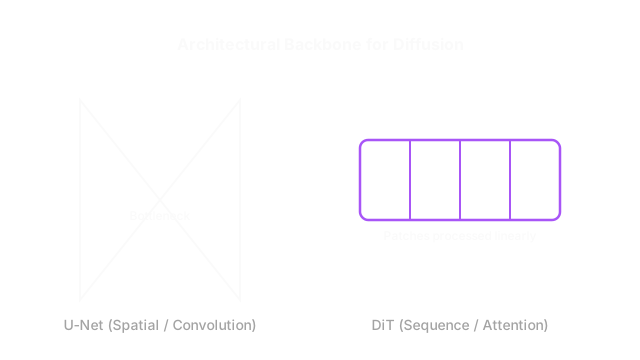
For years, image generation models relied on U-Nets to understand spatial data. Diffusion Transformers threw that away, proving that if you just chop an image into puzzle pieces, the same architecture that powers ChatGPT can also generate world-class images.
Why Does This Exist?
When Denoising Diffusion Probabilistic Models (DDPMs) first took over generative AI, almost every architecture used a U-Net as the "denoiser." The U-Net was the undisputed king of image-to-image tasks because it was originally designed for medical image segmentation; it was excellent at taking in an image, compressing it to understand the global context, and then expanding it back to output a new image of the same size.
However, U-Nets scale poorly. As researchers tried to build massive models with tens of billions of parameters to generate ultra-realistic, high-resolution images, the U-Net's convolutional nature became a severe bottleneck. Meanwhile, the NLP world had already solved the scaling problem with the Transformer architecture. The introduction of the Diffusion Transformer (DiT) answered a simple question: "Can we just replace the U-Net with a standard Transformer and get all the scaling benefits?" The answer was a resounding yes, triggering a massive architectural shift in image and video generation.
Think of It Like This
The Painters
Imagine you hire an artist to clean up a very blurry, static-filled painting.
- The U-Net Approach: The artist steps back to look at the entire canvas, squints their eyes to understand the overall shape (compression/downsampling), and then slowly steps closer, adding fine details to the edges of objects based on the global shape (expansion/upsampling).
- The DiT Approach: The artist chops the canvas into 256 identical square puzzle pieces. They look at all the pieces simultaneously, realizing that "Puzzle Piece 4 (an eye)" strongly correlates with "Puzzle Piece 45 (a mouth)." They use this understanding to clean up the static on every piece at the same time, without ever needing to mentally compress the whole canvas.
How It Actually Works
While both architectures take in a noisy image and output the predicted noise , they process the data in entirely different ways.
1. The U-Net (Spatial Denoising)
A U-Net is a Convolutional Neural Network (CNN). It processes the image through a series of convolutional blocks that progressively halve the spatial resolution while doubling the number of channels (the "downsampling" path). This forces the network to learn a highly compressed representation of what the image actually is (e.g., "this is a dog"). Then, it passes through an "upsampling" path, which doubles the resolution back to the original size. Crucially, it uses "skip connections" to shuttle high-resolution edge details directly from the downsampling path to the upsampling path. This ensures the final denoised image remains incredibly sharp.
2. The Diffusion Transformer (Sequence Denoising)
A DiT abandons convolutions almost entirely. Instead of treating the image as a 2D grid, it treats the image exactly how an LLM treats a paragraph of text.
- Patchify: The noisy image is sliced into non-overlapping patches (e.g., 2x2 or 4x4 pixels).
- Linear Projection: Each patch is flattened into a 1D vector (a "token").
- Self-Attention: These tokens are fed into standard Transformer blocks. Through self-attention, every patch looks at every other patch to figure out how they relate to each other.
- Un-patchify: The sequence of denoised tokens is reshaped back into a 2D image grid.
3. The Scaling Law Advantage
The primary reason the industry shifted toward DiT is predictability. The scaling laws for U-Nets are messy and often plateau. The scaling laws for Transformers are relentless: if you double the compute and double the model size, the loss goes down predictably. This allowed companies like OpenAI (with Sora) and Stability AI (with Stable Diffusion 3) to confidently pour millions of dollars of compute into training massive DiTs, knowing the architecture wouldn't hit a structural wall.
Code
This pseudocode highlights the structural difference between a forward pass in a U-Net versus a DiT.
import torchimport torch.nn as nn
class PseudoUNet(nn.Module): def forward(self, x, t): # x is a spatial 2D tensor (B, C, H, W) down_1 = self.conv_down_1(x) down_2 = self.conv_down_2(down_1) bottleneck = self.bottleneck(down_2) # Skip connections added back up_1 = self.conv_up_1(bottleneck + down_2) up_2 = self.conv_up_2(up_1 + down_1) return up_2 # Returns predicted noise (B, C, H, W)
class PseudoDiT(nn.Module): def forward(self, x, t): # x starts as (B, C, H, W) # 1. Slice image into patches and flatten into a sequence sequence = self.patchify(x) # -> (B, Sequence_Length, Embedding_Dim) # 2. Add time embedding and positional embeddings sequence = sequence + self.pos_embed(t) # 3. Standard transformer blocks (Self-Attention + MLP) for block in self.transformer_blocks: sequence = block(sequence) # 4. Reshape sequence back to image spatial dimensions out_image = self.unpatchify(sequence) # -> (B, C, H, W) return out_imageWatch Out For
Compute Intensity at High Resolutions
Self-attention scales quadratically with sequence length. If you double the resolution of an image, you quadruple the number of patches, meaning the self-attention compute increases by a factor of 16. This makes raw DiTs extraordinarily expensive to train natively on high-resolution images. In practice, DiTs almost always operate on highly compressed "latent" representations of the image, rather than raw pixels.
The Quick Version
- The U-Net was the original backbone of diffusion models, relying on convolutions, downsampling bottlenecks, and skip connections to denoise images.
- The Diffusion Transformer (DiT) replaces convolutions with self-attention, slicing the image into "patches" and processing them like words in a sentence.
- While U-Nets are incredibly efficient at preserving spatial details, their scaling behavior is unpredictable.
- DiTs were adopted because they inherit the proven, relentless scaling laws of standard Transformers, allowing the creation of much larger, more capable models for image and video generation.