Paper breakdown
Are Emergent Abilities a Mirage?
A powerful rebuttal arguing that the 'sudden' appearance of capabilities in LLMs is merely a statistical illusion caused by researchers choosing non-linear, discontinuous metrics.
Paper: Are Emergent Abilities of Large Language Models a Mirage?
Authors: Rylan Schaeffer, Brando Miranda, Sanmi Koyejo · 2023
Read the paper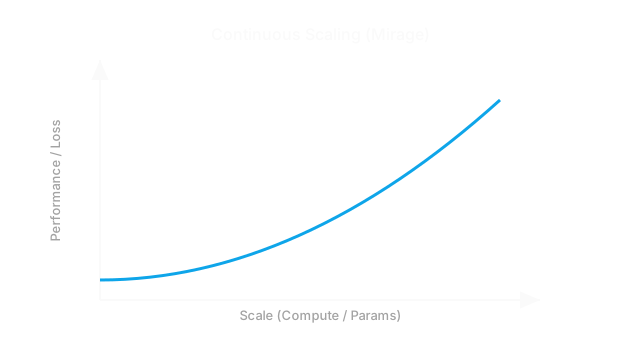
The Problem
The "Emergent Abilities" paper (2022) had convinced the industry that as LLMs scale, they suddenly and unpredictably unlock new capabilities in a sharp "phase transition." This unpredictability was highly concerning for AI safety and made model evaluation difficult.
However, researchers at Stanford noticed a suspicious pattern in the data from the original paper. The tasks that showed "sudden emergence" almost always relied on specific types of evaluation metrics, particularly Exact Match or Multiple Choice.
The Idea
The authors posited a mathematically profound counter-claim: Emergent abilities are an illusion created by the researcher's choice of metric.
If you test a model on a multi-step math problem using an "Exact Match" metric, the model gets 0 points if it is slightly wrong, and 1 point if it is perfectly right. This metric is severely non-linear. The authors hypothesized that the model's underlying intelligence (its ability to predict the correct tokens) is actually improving smoothly and continuously with scale. However, because the metric only rewards perfect accuracy, the visible score stays at 0% until the underlying continuous probability crosses a threshold, causing a sudden, artificial spike.
How It Works
The researchers proved their hypothesis through three steps:
- Mathematical Modeling: They created a mathematical model showing how continuous improvements in per-token probability translate into sharp, step-function jumps when measured by discrete metrics like Exact Match.
- Re-evaluating Real Models: They took the exact same tasks where the original paper claimed "emergence" (e.g., BIG-bench tasks). Instead of measuring them with Exact Match, they measured them with continuous metrics like Brier Score or Token Edit Distance. The "sudden phase transitions" instantly vanished, revealing smooth, predictable, linear improvements with scale.
- Simulating Emergence: To prove their point, they trained shallow, simple vision models (not LLMs) to do basic image classification. By intentionally choosing a harsh, non-linear metric, they artificially induced "emergent" phase transitions in these simple models, proving that the phenomenon is a property of the metric, not a magical property of massive scale.
Why It Mattered
This paper was a massive relief for the AI community. It fundamentally demystified the scaling process. It proved that we can predict the capabilities of a massive, expensive model by testing smaller, cheaper models, provided we use continuous, mathematically sound metrics (like log-probabilities) rather than discrete, pass/fail metrics.
It heavily reduced the fear of sudden, unpredictable "doomsday" capabilities emerging without warning, reframing AI capability scaling as a smooth, predictable engineering curve.
What Came After
The "Mirage" paper definitively shifted the academic consensus. While the term "emergence" is still colloquially used to describe new use cases that become practically viable at scale, the technical claim that capabilities violate predictable continuous scaling laws is now largely considered debunked. This paper is fundamentally tied to the original Emergent Abilities paper, serving as its necessary scientific counterweight.