BitNet (1-bit LLMs)
The 2023 Microsoft paper that challenged the fundamental math of neural networks, proving you can train LLMs where weights are just +1 or -1, eliminating matrix multiplication entirely.
Paper: BitNet: Scaling 1-bit Transformers for Large Language Models
Authors: Hongyu Wang, Shuming Ma, Li Dong, Shaohan Huang, Huaijie Wang, Lingxiao Ma, Fan Yang, Ruiping Wang, Yi Wu, Furu Wei · 2023
Read the paper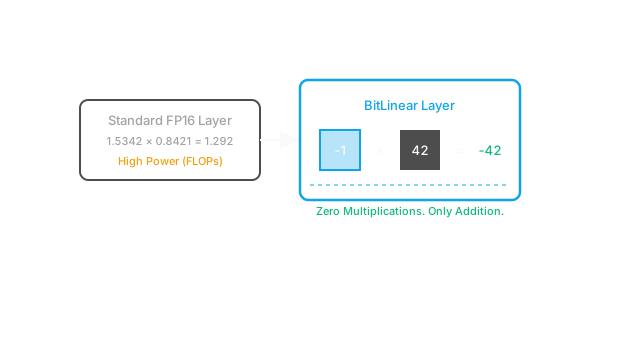
The Problem
The AI industry's insatiable demand for compute is driven by Matrix Multiplication. A standard LLM stores its weights in 16-bit floating-point numbers (FP16). To generate text, the GPU must perform trillions of floating-point multiplications (FLOPs). This requires massive amounts of power and specialized silicon. While "post-training quantization" (like QLoRA) shrinks the weights to 4-bit after training, the math is still done in 16-bit. Researchers dreamed of training a model natively in 1-bit, which would replace expensive multiplications with cheap addition, but previous attempts severely degraded the model's intelligence.
The Idea
Microsoft researchers designed BitNet, a Transformer architecture where the weights are strictly ternary (-1, 0, +1), which is essentially 1.58 bits. They completely replaced the standard nn.Linear layers with BitLinear layers. Instead of floating-point multiplication, computing the forward pass of BitNet only requires simple integer addition. They proved that if you train the model from scratch with this constraint, it matches the performance of standard 16-bit LLMs while consuming a fraction of the memory and energy.
How It Works
The BitLinear layer works differently than standard layers:
- Weight Quantization: During the forward pass, the continuous weights are binarized (or ternarized) to -1, 0, or +1 using a sign function.
- Activation Quantization: The inputs (activations) to the layer are also quantized to 8-bit integers.
- The Math: Because the weights are just 1 or -1, calculating doesn't require multiplying floating point numbers. It just requires adding or subtracting the 8-bit activations. This completely removes the need for FLOPs, replacing them with Integer ADDs.
- Training (Straight-Through Estimator): Because the sign function is not differentiable, training uses the STE to bypass the quantization step during backpropagation, allowing the model to learn the optimal 1-bit configuration.
Why It Mattered
BitNet (specifically its successor, the "1.58-bit" paper) represents a potential paradigm shift in AI hardware. If 1-bit LLMs become the standard, we won't need expensive, power-hungry GPUs optimized for floating-point math. We can build entirely new, vastly cheaper silicon (like custom ASICs or FPGAs) optimized purely for integer addition, drastically lowering the cost of serving AI.
What Came After
The paper sparked a race to optimize 1-bit inference kernels. While currently held back by the fact that modern GPUs are hardwired for FP16 math (making 1-bit models run slower than they theoretically should on current hardware), open-source implementations like BitNet.cpp are paving the way for running massive LLMs on standard CPUs and phones.