Deep Double Descent
The 2019 paper that broke classical statistical theory, proving that making a neural network "too big" actually causes its error rate to drop again after an initial spike.
Paper: Deep Double Descent: Where Bigger Models and More Data Hurt
Authors: Preetum Nakkiran, Gal Kaplun, Yamini Bansal, Tristan Yang, Boaz Barak, Ilya Sutskever · 2019
Read the paper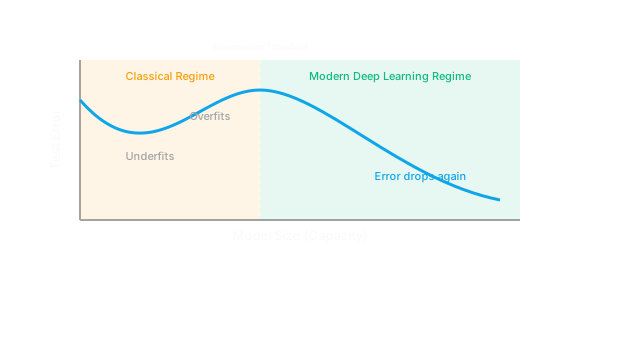
The Problem
For decades, the foundation of machine learning was the Bias-Variance Tradeoff (the U-shaped curve). If a model is too small, it underfits (high error). If it's the right size, it generalizes well (low error). If it's too big (more parameters than data points), it overfits—it memorizes the training data perfectly, but its test error skyrockets. But in deep learning, practitioners were routinely training massive neural networks with billions of parameters on millions of data points (grossly "over-parameterized"), yet the models generalized beautifully. Classical statistical theory could not explain why modern deep learning worked.
The Idea
Researchers from OpenAI and Harvard empiricalized the "Deep Double Descent" phenomenon. They mapped the test error of neural networks across a massive range of sizes (model capacity). They proved that classical theory was only half right. The U-shaped curve happens first. But if you keep making the model even bigger, passing the "interpolation threshold" (where the model perfectly memorizes the training data), the test error magically goes back down again, and continues to drop the larger the model gets.
How It Works
The Double Descent curve has three zones:
- Under-parameterized Regime (Classical): As model size increases, test error drops, then starts rising (overfitting). This matches classical statistics.
- The Interpolation Threshold (The Peak): When the model has exactly enough parameters to fit the training data perfectly, there is only one mathematical solution. This solution is usually extremely complex and "spiky," leading to terrible generalization and the highest possible test error.
- Over-parameterized Regime (Modern Deep Learning): As the model gets even larger, there are now infinitely many mathematical ways to fit the training data. The implicit regularization of Stochastic Gradient Descent (SGD) naturally finds the "smoothest," simplest solution among these infinite choices, causing the test error to drop again.
Why It Mattered
This paper finally provided the theoretical justification for the entire modern AI industry's strategy: "just make it bigger." It resolved the glaring contradiction between classical statistical theory and empirical deep learning results, proving that massive over-parameterization is actually a feature, not a bug.
What Came After
Double descent was observed across all architectures (CNNs, Transformers) and even during the training process over time (epoch-wise double descent). It cemented the "Scaling Laws" mindset that dominated the next five years of AI research.