DINOv2
The 2023 paper from Meta that produced state-of-the-art self-supervised visual features, matching supervised models without using any labels or text.
Paper: DINOv2: Learning Robust Visual Features without Supervision
Authors: Maxime Oquab, Timothée Darcet, Théo Moutakanni, Hervé Jégou, Piotr Bojanowski, Bojan Misra, Armand Joulin, Edouard Grave · 2023
Read the paper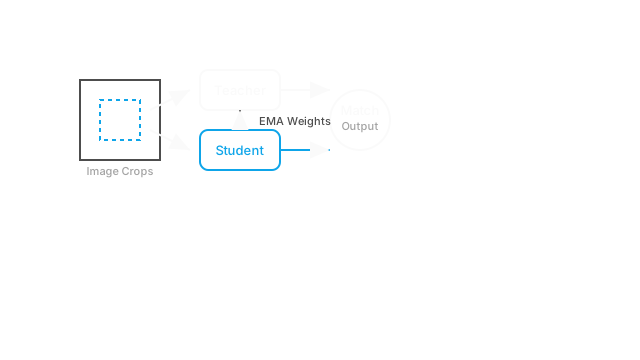
The Problem
While CLIP showed that text supervision creates powerful visual representations, it inherently misses visual details that humans don't bother describing in text (like fine-grained depth, specific object parts, or complex spatial relations). Models trained purely on images (self-supervised learning) like DINOv1 existed, but they struggled to scale and suffered from unstable training, meaning they couldn't compete with massive models like CLIP.
The Idea
Meta developed DINOv2, proving that you can train a Vision Transformer using self-supervised learning (no text, no labels) at massive scale, resulting in visual features that are actually superior to CLIP for downstream tasks requiring fine-grained understanding. They achieved this by building a massive, curated dataset (LVD-142M) and stabilizing the training of the iBOT/DINO architecture.
How It Works
DINOv2 combines several self-supervised techniques:
- Teacher-Student Knowledge Distillation: The model creates two different "views" of an image (e.g., a local crop and a global crop). A "Student" network sees the local crop and must predict the output of a "Teacher" network that saw the global crop. The Teacher's weights are an exponential moving average of the Student's weights.
- Masked Image Modeling (iBOT): Similar to BERT for text, random patches of the student's image are masked out, and it must predict the teacher's features for those masked patches.
- High-Resolution Training: Toward the end of training, the image resolution is increased for a short time to help the model learn fine-grained details.
The resulting embeddings capture deep semantic meaning. If you apply PCA to DINOv2 patch embeddings, you can literally see distinct objects and parts segmenting themselves in the principal components.
Why It Mattered
DINOv2 proved that language is not strictly necessary to learn world-class visual representations. Its features transfer extraordinarily well "frozen" (without fine-tuning) to tasks like depth estimation, semantic segmentation, and image retrieval, outperforming CLIP on dense pixel-level tasks.
What Came After
DINOv2 embeddings became a widely used foundation for downstream vision applications. Because the embeddings inherently cluster into object parts, they were adopted by researchers building segmentation tools and robotic manipulation systems where pixel-level understanding is more important than open-vocabulary classification.