Paper breakdown
Knowledge Distillation
Formalized Knowledge Distillation, a method for training small, fast 'student' models to mimic the nuanced behavior of massive 'teacher' models.
Paper: Distilling the Knowledge in a Neural Network
Authors: Geoffrey Hinton, Oriol Vinyals, Jeff Dean · 2015
Read the paper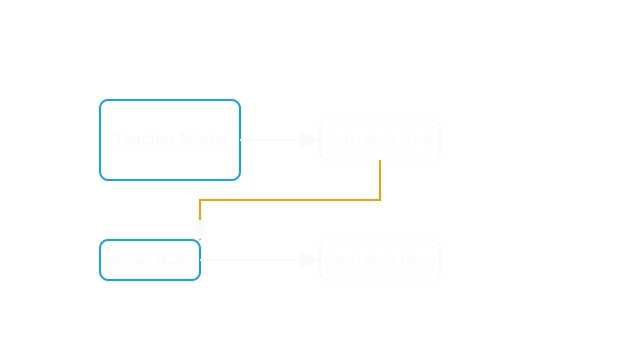
The Problem
To achieve state-of-the-art accuracy, researchers trained massive ensembles of heavy neural networks. While great for winning competitions, these cumbersome models were entirely impractical to deploy in the real world (e.g., on a mobile phone or for low-latency web services). How can we get the performance of a massive ensemble in a model small enough to run on a smartphone?
The Idea
Hinton and team proposed transferring the 'knowledge' of the massive model (the Teacher) to a small, fast model (the Student). The key insight was that the true knowledge of a model isn't just in its final hard prediction, but in its 'soft' probabilities.
How It Works
When a large image model looks at a picture of a BMW, it might output a 98% probability for 'Car', but also a 1.5% probability for 'Truck' and a 0.0001% probability for 'Carrot'.
These tiny probabilities (the 'dark knowledge') are incredibly valuable. They tell the model that a car is visually closer to a truck than to a carrot. If you only train a small network on the hard 'Car' label, it misses all this rich relational information.
In Knowledge Distillation, you take the Teacher's final output scores (logits) and divide them by a 'Temperature' parameter before passing them through a softmax. This softens the probabilities, amplifying the tiny numbers. The Student network is then trained to match these soft probabilities, effectively forcing it to learn the exact same internal logic and generalizations as the massive Teacher.
Why It Mattered
Knowledge Distillation proved that you could compress the performance of massive architectures into models a fraction of the size. It became a cornerstone of efficient AI deployment, allowing companies to serve high-accuracy models at scale without bankrupting themselves on compute costs.
What Came After
Distillation is more critical today than ever. The massive open-source LLMs we run on consumer hardware today (like Llama 3 8B or DeepSeek-R1 distilled models) rely heavily on distillation techniques to capture the reasoning capabilities of their massive 70B+ parameter siblings.