GPT-4
The 2023 technical report from OpenAI detailing the model that defined the frontier of AI capabilities, demonstrating human-level performance on professional benchmarks.
The Problem
By late 2022, GPT-3.5 (ChatGPT) had demonstrated that LLMs could converse fluently, but they struggled with complex reasoning, coding, and standardized testing. More critically for OpenAI, training massive models like GPT-4 was a multi-million dollar gamble. If you train a model for 3 months on 10,000 GPUs, you need to know before you start exactly how smart it will be when it finishes. Trial and error at that scale was financially impossible.
The Idea
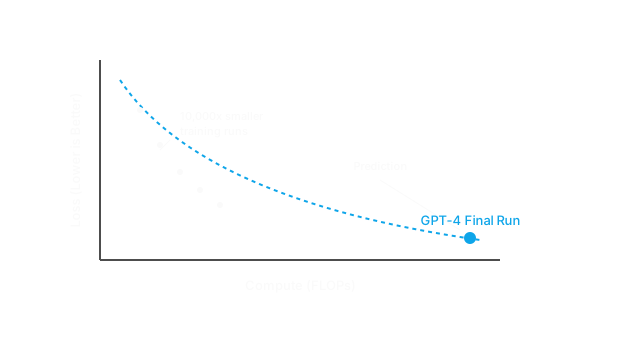
GPT-4 represented a massive leap in engineering discipline. The defining breakthrough wasn't a specific architectural trick (though it was multimodal from the ground up), but rather the mastery of "predictable scaling." OpenAI developed infrastructure so stable and mathematical theories so precise that they could accurately predict GPT-4's final performance (loss) by training models that used 10,000x less compute.
How It Works
While the exact architecture of GPT-4 was kept secret (widely suspected to be a massive Mixture-of-Experts), the report detailed its capabilities and alignment:
- Multimodality: GPT-4 was natively trained on interleaved text and images, allowing it to "see" and reason about charts, diagrams, and photos.
- Reasoning: It exhibited a massive leap in reasoning capabilities, passing the Uniform Bar Exam in the 90th percentile (GPT-3.5 was in the 10th percentile).
- Post-Training Alignment: OpenAI heavily emphasized their safety pipeline. They used RLHF (Reinforcement Learning from Human Feedback) extensively and engaged "Red Teams" (experts who try to hack the model) for months to force the model to refuse dangerous prompts (like how to synthesize chemicals).
Why It Mattered
GPT-4 became the gold standard against which all other AI models were measured for over a year. It shifted the industry focus from "can the model talk?" to "can the model reason and execute complex, multi-step tasks?" Its release officially kicked off the enterprise AI boom.
What Came After
GPT-4 was iterated upon with GPT-4 Turbo (larger context window, lower cost) and GPT-4o (omni-model natively supporting real-time audio and vision). The secrecy of the report also marked the definitive end of the "open research" era for frontier labs.