Paper breakdown
Lost in the Middle
A landmark empirical study revealing that despite massive context windows, LLMs systematically fail to retrieve information hidden in the middle of long documents.
Paper: Lost in the Middle: How Language Models Use Long Contexts
Authors: Nelson F. Liu, Kevin Lin, John Hewitt, Ashwin Paranjape, Michele Bevilacqua, Freek Petroni, Percy Liang · 2023
Read the paper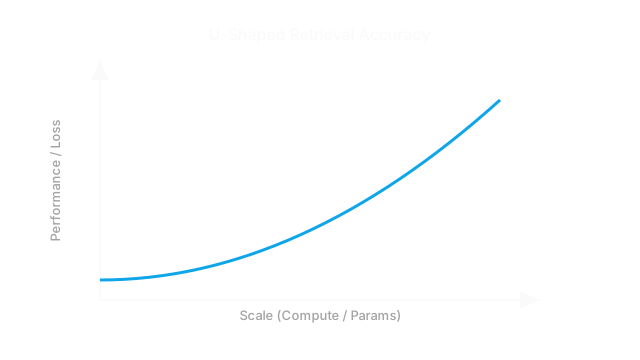
The Problem
By 2023, the API race was defined by context window length. Anthropic released Claude with a 100K token window, and OpenAI responded with GPT-4 32K. Developers rushed to dump massive documents and entire codebases into the prompt, assuming that because the model could ingest 100K tokens, it could reason over them perfectly.
However, developers frequently reported that models seemed to "forget" or hallucinate information when answering questions based on these massive prompts.
The Idea
The researchers at Stanford and UC Berkeley designed a simple, rigorous empirical test. They created a "needle in a haystack" multi-document QA task. They took a question, its exact answer document, and 19 irrelevant distractor documents.
They then tested state-of-the-art models (like GPT-3.5 and Claude 1.3) by placing the exact answer document at different positions within the prompt: at the very beginning, in the exact middle, and at the very end.
How It Works
The paper is purely empirical; it does not introduce a new architecture. The results formed a distinct "U-shaped" performance curve for almost every model tested:
- Primacy Effect: When the answer was in the first few documents (the beginning of the prompt), models retrieved it with high accuracy (e.g., 90%+).
- Recency Effect: When the answer was in the last document (the very end of the prompt), accuracy was also extremely high.
- Lost in the Middle: When the answer was placed anywhere in the middle 50% of the prompt, performance completely collapsed, often plunging below 20% accuracy.
They discovered this failure mode was universal across open and closed models, regardless of whether the model used absolute positional encoding or relative encoding (like RoPE).
Why It Mattered
This paper was a massive reality check for the AI industry. It proved that simply scaling the context window architecturally (e.g., via FlashAttention or ALiBi) did not actually solve the long-context problem.
It radically altered how developers built RAG (Retrieval-Augmented Generation) systems. Instead of passing 50 retrieved documents to the LLM, developers realized they needed to strictly re-rank and filter them down to the top 5, or manually force the most relevant documents to the very beginning or end of the prompt to guarantee the model would actually read them.
What Came After
The "Lost in the Middle" phenomenon sparked an intense wave of research. Model providers began explicitly training models to counter this bias (by forcing them to retrieve random facts from the middle of synthetic documents during fine-tuning).
Subsequent frontier models (like Gemini 1.5 Pro and Claude 3 Opus) specifically targeted this benchmark, famously achieving near 100% "needle in a haystack" retrieval accuracy across 1M+ token windows, effectively solving the raw retrieval aspect of the "Lost in the Middle" problem (though complex multi-step reasoning over long contexts remains challenging).