Paper breakdown
QLoRA
A 2023 breakthrough that combined 4-bit quantization with LoRA, making it possible to fine-tune massive 65-billion parameter models on a single consumer GPU.
Paper: QLoRA: Efficient Finetuning of Quantized LLMs
Authors: Tim Dettmers, Artidoro Pagnoni, Ari Holtzman, Luke Zettlemoyer · 2023
Read the paper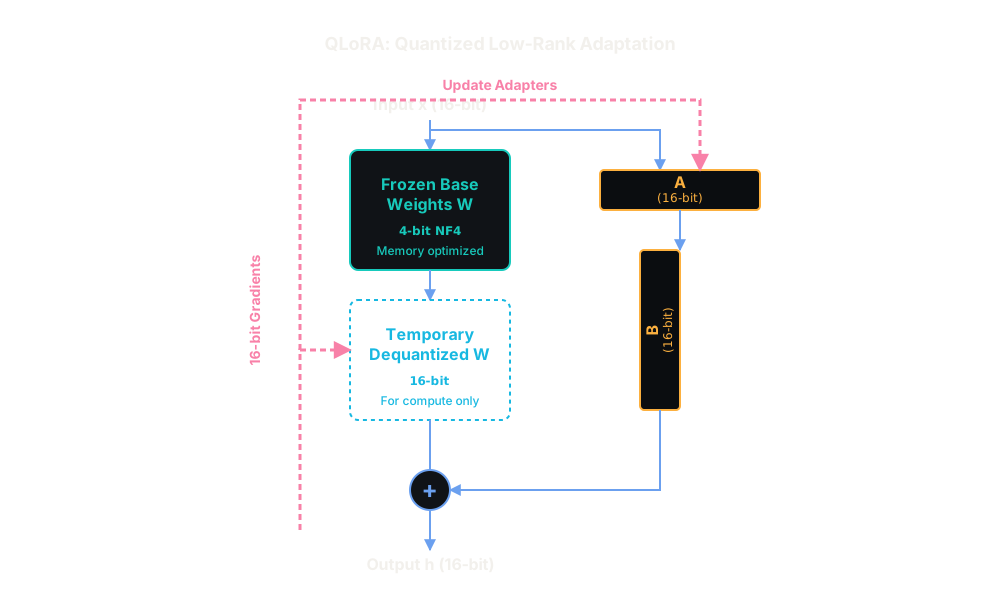
The Problem
LoRA (Low-Rank Adaptation) successfully solved the problem of updating massive numbers of parameters by only training tiny adapter matrices. However, there was still a major hurdle: memory.
Even if you are only training 0.1% of the model's parameters (the LoRA adapters), you still have to load the other 99.9% of the model (the base weights) into GPU memory just to do the forward and backward passes. For a 65-billion parameter model like LLaMA, storing the 16-bit base weights required over 130 GB of VRAM. That meant you still needed multiple expensive server GPUs simply to hold the model in memory, putting fine-tuning out of reach for researchers with a single GPU.
If you tried to solve this by quantizing (compressing) the base model down to 8-bit or 4-bit precision, standard quantization techniques would destroy the model's accuracy, causing the fine-tuning process to collapse.
The Idea
The authors introduced QLoRA (Quantized LoRA), a set of techniques designed to allow backpropagation through a heavily quantized, 4-bit base model without degrading performance.
QLoRA takes the massive base model and squashes it down to 4 bits per parameter, shrinking the memory footprint by 4x compared to 16-bit precision. It keeps this base model entirely frozen. It then attaches standard 16-bit LoRA adapters. During training, the gradients flow backward through the frozen 4-bit base model and into the 16-bit LoRA adapters, which are the only parts of the network that actually get updated.
How It Works
To make 4-bit training work without destroying the model, QLoRA introduced three crucial innovations:
- 4-bit NormalFloat (NF4): Standard quantization evenly spaces the "buckets" that numbers can fall into. But neural network weights aren't distributed evenly; they form a bell curve (normal distribution) clustered around zero. NF4 is a new data type mathematically optimized for normally distributed weights. It puts more buckets near zero where most the weights are, and fewer buckets at the extremes, capturing far more information in just 4 bits than standard quantization.
- Double Quantization: Even after quantizing the weights, the "scaling factors" (the numbers used to decompress the 4-bit buckets back to 16-bit for math operations) take up a lot of memory. Double Quantization runs a second pass of quantization on the scaling factors themselves, saving an additional 0.37 bits per parameter (which adds up to gigabytes of savings on a 65B model).
- Paged Optimizers: During training, optimizer states (like the momentum in AdamW) can occasionally spike and cause an Out-Of-Memory (OOM) error. QLoRA uses NVIDIA unified memory to seamlessly page optimizer states out to CPU RAM when the GPU gets too full, preventing crashes.
During the forward and backward passes, the 4-bit weights are temporarily decompressed (dequantized) to 16-bit in the GPU registers just in time to do the math, and then the 16-bit gradients are passed to the LoRA adapters.
Why It Mattered
QLoRA was a watershed moment for the open-source AI community. It proved that you could fine-tune a state-of-the-art 65B parameter model on a single 48GB GPU, or a 33B model on a single 24GB consumer gaming GPU (like an RTX 4090), with zero performance degradation compared to full 16-bit fine-tuning.
This completely shattered the monopoly that massive tech companies had on training large models. Within weeks of the QLoRA release (and the release of the Guanaco models trained using it), the open-source community exploded with thousands of custom fine-tunes. Anyone with a high-end gaming PC could now download a massive foundational model and fine-tune it on their own private data.
What Came After
QLoRA became the absolute standard for fine-tuning open-source models. The techniques introduced in this paper (especially the NF4 data type) were integrated into major libraries like HuggingFace transformers and bitsandbytes, making 4-bit quantization a one-line configuration flag.
It also drove intense interest into even lower-bit quantization. Researchers began exploring 3-bit, 2-bit, and even 1-bit (ternary) models (like BitNet), pushing the boundaries of how little information a neural network actually needs to retain its reasoning capabilities.