Paper breakdown
Scaling Monosemanticity
Anthropic's 2024 paper successfully applied Sparse Autoencoders to Claude 3 Sonnet, extracting millions of high-level, interpretable concepts (like 'Golden Gate Bridge' or 'security vulnerabilities') from a state-of-the-art production model.
Paper: Scaling Monosemanticity: Extracting Interpretable Features from Claude 3 Sonnet
Authors: Adly Templeton, Tom Conerly, Jonathan Marcus, Jack Lindsey, Trenton Bricken, Brian Chen, Adam Pearce, Craig Citro, Erica Durkan, Christopher Olah, et al. · 2024
Read the paper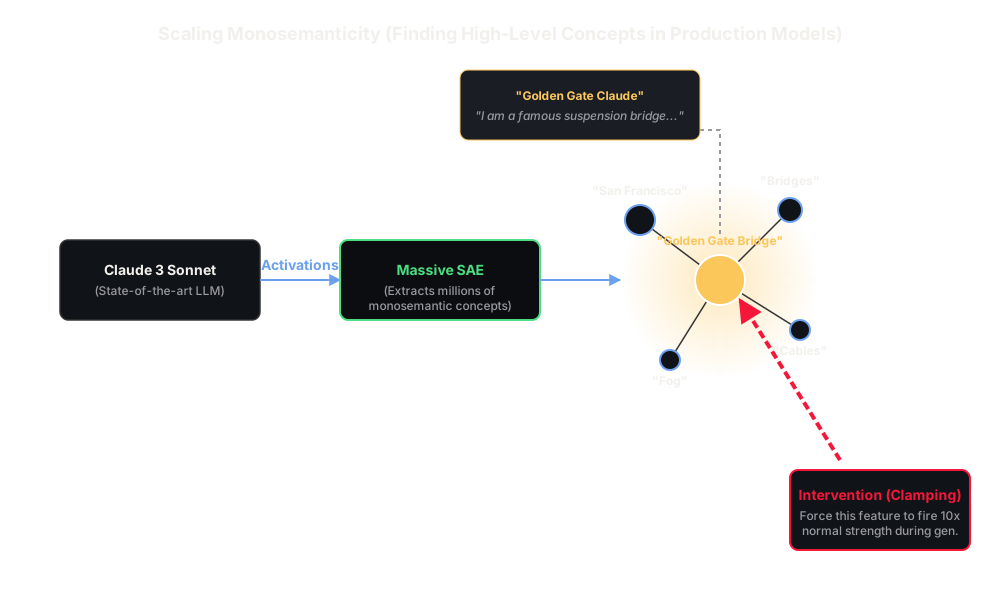
The Problem
Anthropic's previous paper, Towards Monosemanticity, proved that Sparse Autoencoders (SAEs) could successfully extract clean, understandable concepts from a neural network. However, that experiment was conducted on a tiny, one-layer "toy" model.
The interpretability community was skeptical about whether this technique could scale. State-of-the-art models like Claude 3 Sonnet have tens of billions of parameters, hundreds of layers, and are trained on massive datasets. The computational cost of training an SAE on a model that large is immense. Furthermore, nobody knew if a large model would actually learn clean, high-level human concepts (like "deception" or "coding errors"), or if the concepts would just become an uninterpretable mess of high-dimensional alien math.
The Idea
The Anthropic team decided to brute-force the scaling problem. They trained massive Sparse Autoencoders on the middle layers of Claude 3 Sonnet, a frontier, production-grade LLM.
Because Sonnet's activations were so complex, they trained an SAE to extract millions of different features. The goal was to map out the "mind" of Claude 3 Sonnet—to create a dictionary where each entry is a specific human concept and its corresponding mathematical signature inside the neural network.
How It Works (and What They Found)
The training process was the same as the previous paper, just on a vastly larger scale. They passed billions of tokens through Claude 3 Sonnet, captured the activations at the middle layer, and trained an SAE to reconstruct those activations sparsely.
The results were spectacular. The SAE extracted millions of highly abstract, perfectly interpretable concepts. They found specific features that fired for:
- Cities (e.g., San Francisco)
- People (e.g., specific politicians or scientists)
- Abstract concepts (e.g., inner conflict, keeping secrets)
- Code structures (e.g., function calls, API errors)
- Security vulnerabilities (e.g., a feature that activates only when reading unsafe code)
Even more impressively, they mapped the "neighborhoods" of these concepts. For example, the feature for "Inner Conflict" was mathematically located near the features for "Keeping Secrets," "Lying," and "Self-Deception."
Golden Gate Claude
To prove that these features were causal (and not just correlations), they artificially clamped a feature "on." They found a feature corresponding to the Golden Gate Bridge. When they forced that specific feature to stay maximally active during generation, Claude's personality completely changed. It started believing it was the Golden Gate Bridge.
If you asked it, "How are you?", it would respond, "I'm doing great, feeling a bit breezy here in the bay." It hallucinated cables, fog, and cars driving over it. This viral demo ("Golden Gate Claude") conclusively proved that SAEs isolate the actual levers of cognition within the model.
Why It Mattered
Scaling Monosemanticity proved that the "black box" of AI is not permanently sealed. It showed that the internal representations of frontier models align incredibly well with human concepts.
This is a massive win for AI safety. If we can map the features for "deception," "bias," or "bioweapons knowledge," we can theoretically monitor the model's brain in real-time. If a user asks a seemingly innocent question, but the "bioweapons" feature lights up inside the model's brain, the system can instantly halt generation before the unsafe text is even produced.
What Came After
This paper launched the "scaling era" of Mechanistic Interpretability. OpenAI quickly followed up by releasing their own massive SAEs trained on GPT-4, finding similar high-level concepts.
The industry is now racing to create comprehensive "atlases" of AI brains, mapping every single concept a model knows. While training these massive SAEs is computationally expensive (often taking as much compute as training a small LLM), it is currently the most promising path toward guaranteeing that superintelligent AI systems are safe, aligned, and acting without hidden deceptive motives.