Paper breakdown
Towards Monosemanticity
A 2023 mechanistic interpretability paper by Anthropic that successfully used Sparse Autoencoders to extract understandable, human-readable concepts from the impenetrable 'black box' of neural network activations.
Paper: Towards Monosemanticity: Decomposing Neural Networks with Sparse Autoencoders
Authors: Trenton Bricken, Aditi Ramesh, Stanislav Fort, Damian Gil, Nassim Oufattole, Christopher Olah, Nelson Elhage · 2023
Read the paper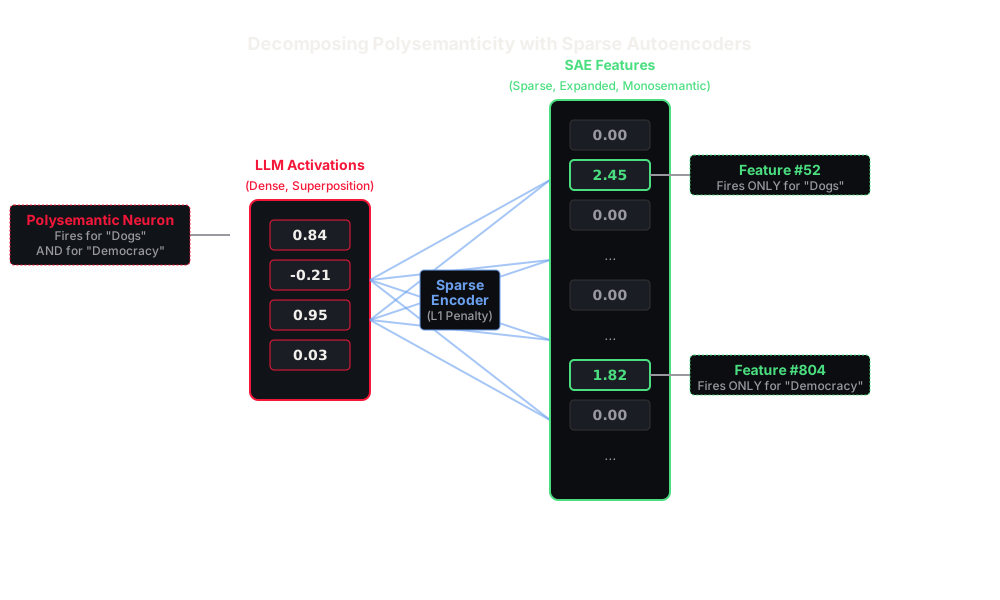
The Problem
Neural networks are famous for being "black boxes." Unlike traditional software where we can read the code to see exactly what it's doing, a neural network is just a massive matrix of numbers.
For a long time, researchers hoped they could look at individual "neurons" (activations) in a network and understand what they do. Perhaps Neuron #452 always fires when the model sees a dog, and Neuron #991 fires when it sees French text.
However, researchers quickly discovered the problem of Polysemanticity. Because neural networks need to represent more concepts than they have neurons, they use a trick called superposition. They compress concepts by having multiple concepts share the same neurons. Neuron #452 might fire for dogs, but also for the concept of "democracy," and also for the color blue. This makes it completely impossible for a human to look at a single neuron and understand what the model is "thinking."
The Idea
Anthropic's Mechanistic Interpretability team set out to solve polysemanticity. They wanted to take the dense, compressed, confusing activations of a neural network and decompress them into "Monosemantic" features—where one feature corresponds to exactly one understandable human concept.
To do this, they used a Sparse Autoencoder (SAE). An SAE is a small, separate neural network trained to observe the activations of the main language model.
The SAE takes a dense activation vector from the language model and expands it into a much larger, higher-dimensional space. Crucially, it applies an L1 penalty, which forces the SAE to be sparse. This means that out of thousands of possible features in the expanded space, the SAE is only allowed to "turn on" a tiny handful of them at any given time to reconstruct the original activation.
How It Works
- Run the Main Model: You feed text through a standard language model and capture the activations (the numbers flowing through the network) at a specific layer.
- Train the SAE: You train the Sparse Autoencoder to take those activations, blow them up into a larger dimension, and then compress them back down to match the original activations.
- Enforce Sparsity: Because of the L1 penalty, the SAE is forced to find a representation where almost all of the values in the middle layer are exactly zero, and only a few "spikes" are active for any given input.
When the researchers looked at the "spikes" (the features) in the middle layer of the SAE, they found exactly what they were looking for: Monosemanticity.
Instead of neurons that fired for a random jumble of concepts, the SAE features were incredibly specific and interpretable. They found distinct features that fired only for:
- Base64 encoded strings
- Hebrew text
- The concept of DNA sequences
- Contact information (names and phone numbers)
Even better, they proved they could actively intervene on these features. If they artificially boosted the activation of the "Base64" SAE feature, the language model would suddenly start hallucinating Base64 text. This proved that these features were not just statistical artifacts; they were the actual conceptual building blocks the model was using to generate text.
Why It Mattered
This paper was a massive breakthrough in AI safety and interpretability. For the first time, researchers had a reliable mathematical tool to crack open the black box of a language model and read its "mind."
Before this, we could only test models behaviorally (by asking them questions and seeing if they lie or say dangerous things). With SAEs, we theoretically have the power to look inside the model and see if the "deception" feature or the "bioweapons knowledge" feature is activating, even if the model is trying to hide it.
What Came After
This paper successfully proved the concept on a tiny, toy model (a one-layer transformer). The immediate question was: will this technique scale? Will Sparse Autoencoders work on massive, state-of-the-art models with billions of parameters? That question was answered a few months later in their follow-up paper, Scaling Monosemanticity.