Paper breakdown
XGBoost
Introduced XGBoost, a highly scalable and regularized gradient boosting library that utterly dominated Kaggle competitions and tabular data modeling.
Paper: XGBoost: A Scalable Tree Boosting System
Authors: Tianqi Chen, Carlos Guestrin · 2016
Read the paper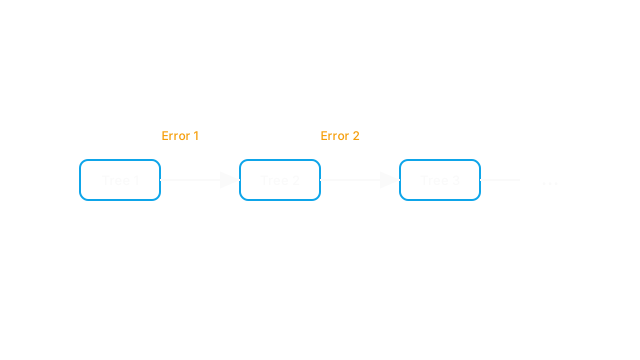
The Problem
Gradient Boosted Decision Trees (GBDT) were theoretically powerful, but existing implementations were slow, prone to overfitting if not tuned carefully, and couldn't easily scale to massive datasets that couldn't fit in memory.
The Idea
The authors didn't invent Gradient Boosting, but they perfected it. They engineered a system that combined aggressive mathematical regularization with brilliant hardware-level optimizations to make tree boosting blazing fast and highly accurate.
How It Works
Like all boosting methods, XGBoost builds trees sequentially. Tree 1 makes a prediction. Tree 2 is trained to predict the error (the residual) of Tree 1. Tree 3 predicts the error of Trees 1 and 2, and so on.
XGBoost introduced several critical innovations:
- Regularized Objective: It mathematically penalizes complex trees (too many leaves, or leaf weights that are too large), pushing the model to learn simple, generalizable patterns.
- Second-Order Approximation: It uses a second-order Taylor expansion (using both the gradient and the Hessian) of the loss function, allowing for faster and more accurate optimization.
- Sparsity Awareness: It automatically learns the best default direction to send missing data at every node split.
- Hardware Optimization: It introduced cache-aware access patterns and out-of-core computing, allowing it to process data that didn't fit in RAM.
Why It Mattered
XGBoost broke Kaggle. For several years, almost every winning solution in tabular data competitions was either a standalone XGBoost model or an ensemble heavily relying on it. It proved that for structured, tabular data, gradient boosted trees were superior to deep neural networks.
What Came After
XGBoost remains one of the most deployed machine learning algorithms in the world for business and financial data. It inspired subsequent optimized boosting frameworks like Microsoft's LightGBM and Yandex's CatBoost, which continue to reign supreme in the tabular data domain.