AI Code Completion Assistant
AdvancedOn this page
Overview
An AI Code Completion Assistant (like GitHub Copilot or Tabnine) provides real-time, inline code suggestions directly within an IDE. Unlike conversational chatbots, it operates primarily via "ghost text" predictions while the user types. The defining challenge is extreme low-latency requirements (< 150ms) combined with intelligent context assembly within a strictly constrained LLM context window.
Functional Requirements
- Provide multi-line or inline code completions as the user types.
- Understand the context of the current file and related files in the workspace.
- Filter out suggestions containing leaked secrets or toxic code.
- Support manual triggering and conversational chat via a side panel.
Non-Functional Requirements
- Sub-150ms latency for ghost text generation to feel instantaneous and avoid disrupting flow.
- Efficient prompt construction that maximizes relevance within a strict token budget (e.g., 2048 to 8192 tokens) to save compute.
- Debouncing and cancellation of inflight requests if the user keeps typing.
- High throughput and GPU autoscaling to handle global developer working hours.
Capacity Estimation
Assume 10 Million Daily Active Developers using the tool for 4 hours a day.
- Request Rate: Developers type constantly, but debouncing limits requests. At 1 request every 2 seconds per active developer, that's 5M * 0.5 = 2.5 Million QPS globally.
- Cancellation Rate: 80-90% of requests are cancelled mid-flight because the developer kept typing before the LLM responded, requiring highly efficient queue management at the Inference Gateway.
- Compute: Serving 2.5M QPS requires tens of thousands of GPUs running specialized, smaller code models (e.g., 7B-15B parameters) optimized for fast inference (Fill-In-The-Middle tasks).
High-Level Architecture
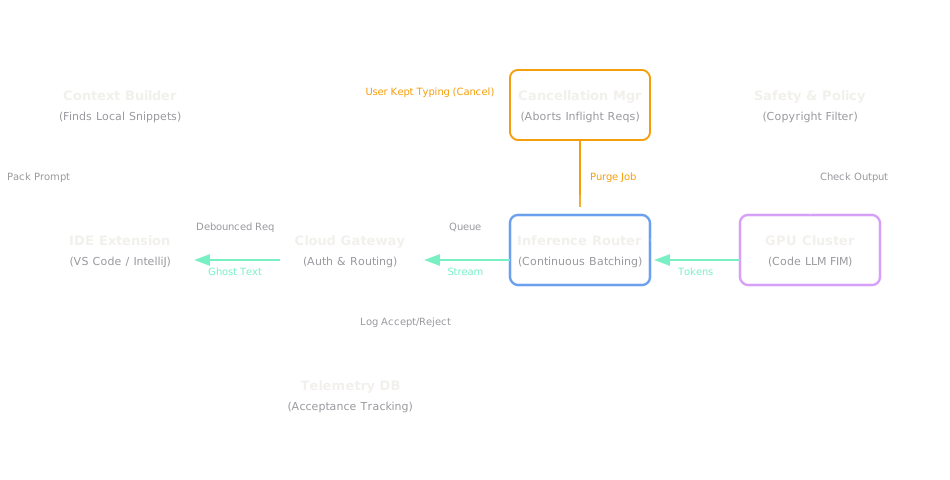
The system spans the client IDE and the cloud backend. The IDE Extension monitors keystrokes and debounces requests. When triggered, the Context Analyzer (client-side) gathers the code above and below the cursor, recently opened files, and imported signatures. It packs this into a prompt and sends it to the Cloud API Gateway. The Gateway routes to the Inference Router, which queues the request for the GPU Cluster. If the user types another key, the IDE sends a cancellation signal, instantly dropping the request from the GPU queue. Completed completions pass through a Post-processing filter (syntax checking, safety) before rendering as ghost text in the IDE.
Data Model
| Entity | Fields / Schema | Storage Choice |
|---|---|---|
| telemetry_logs | event_id, user_id, snippet_hash, accepted (boolean), latency_ms | Data Lake (S3 / BigQuery) |
| user_settings | user_id, model_preference, safety_level, telemetry_opt_in | Relational DB (PostgreSQL) |
Detailed Design
Context Assembly (Client-Side)
Because sending the entire repository to the LLM on every keystroke is impossible due to latency and token limits, the IDE extension uses heuristics. It utilizes Jaccard similarity to find relevant snippets in recently accessed files, grabs the signatures of imported libraries, and explicitly includes the text directly above and below the cursor (for Fill-In-The-Middle or FIM generation). This context is packed tightly to fit the exact token budget.
Debouncing and Request Cancellation
To prevent melting the GPU cluster, the IDE extension debounces typing (e.g., waiting 50ms after a keystroke before requesting). More importantly, if a request is sent and the user types again, the client sends an HTTP/2 RST_STREAM frame or a specific cancellation API call. The Inference Router intercepts this and immediately purges the request from the vLLM continuous batching queue, saving massive compute.
Model Choice and Speculative Decoding
Code completion models are smaller (7B-15B parameters) to ensure ultra-low latency. They are trained specifically on the FIM objective (prefix, suffix, middle). Advanced implementations use Speculative Decoding: a tiny, ultra-fast draft model generates 5-10 tokens, and the larger model validates them in a single forward pass, dramatically speeding up the Time Between Tokens.
Bottlenecks & Solutions
The primary bottleneck is Inference Latency during Peak Hours. To hit the 150ms budget, the model weights must reside entirely in SRAM/HBM without paging, and KV cache must be highly optimized. Geographic routing is essential: developers in India must hit Asia-based GPU clusters, and developers in the US must hit US-based clusters to avoid 50-100ms of sheer network transmission delay.