Probabilistic Data Structures
On this page
Overview
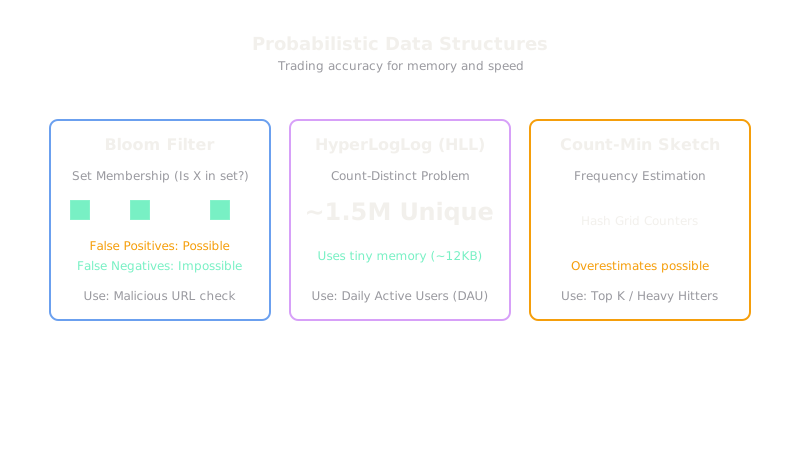
Probabilistic data structures answer set-membership and cardinality questions using far less memory than exact structures, in exchange for a bounded, tunable error rate. The Bloom filter is the canonical example: it can report that an item is possibly present or definitely absent, meaning it may return false positives but never false negatives.
Key Concepts
A Bloom filter is a bit array of size m paired with k independent hash functions. To insert an item, hash it with all k functions and set the bits at those positions. To query an item, hash it the same way and check those bits: if any bit is 0 the item is definitely absent; if all are 1 the item is probably present.
False positives arise because different items can set overlapping bits, so a query may find all its bits set by chance. False negatives are impossible: once an item's bits are set, they are never cleared, so a stored item always tests positive. The false-positive rate rises as the filter fills and is tuned by choosing m and k for the expected item count. Standard Bloom filters do not support deletion; counting Bloom filters trade extra space to allow it. Related structures include HyperLogLog for cardinality estimation and Count-Min Sketch for frequency estimation.
| Structure | Question answered | Error profile |
|---|---|---|
| Bloom filter | Is this item in the set? | False positives possible, never false negatives |
| HyperLogLog | How many distinct items? | Bounded estimate error |
| Count-Min Sketch | How frequent is this item? | Overestimates only |
Trade-offs
A Bloom filter can shrink membership state by an order of magnitude, which lets it live in memory as a fast guard in front of slow storage. The price is occasional false positives that trigger an unnecessary check, so it suits workloads where a wrong "maybe" is cheap but a missed "no" is expensive. It also cannot list its contents or, in the basic form, delete entries, so it complements rather than replaces an exact index.
Interview Tips
- Lead with the asymmetry: "possibly present" versus "definitely absent" is the whole value.
- Give a use case where a false positive is harmless, such as a pre-check before a disk read.
- Note the tuning knobs
m(bits) andk(hashes) and that the error rate grows as the filter fills. - Mention counting Bloom filters if the interviewer asks about deletion.
Summary
- Probabilistic data structures save memory by allowing a small, bounded error.
- A Bloom filter tests set membership with a bit array and multiple hash functions.
- It may return false positives but never false negatives, so a negative answer is always correct.
- The false-positive rate is tuned via the bit-array size and number of hash functions.
- Bloom filters excel as cheap in-memory guards in front of expensive storage lookups.