Service Discovery
On this page
Overview
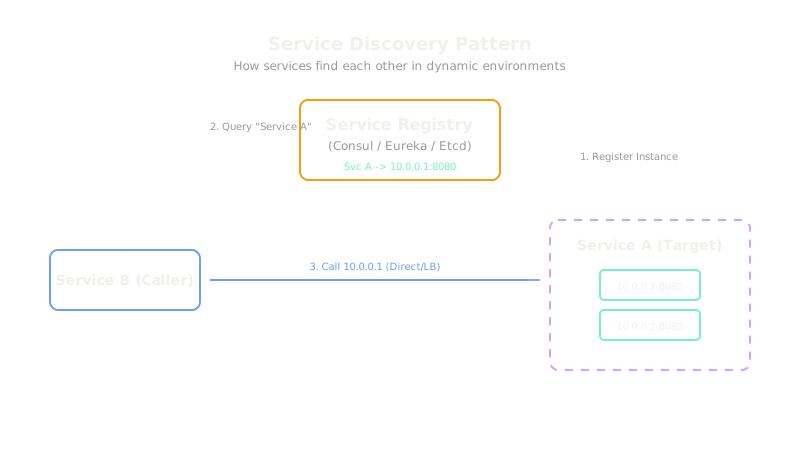
Service Discovery is how microservices find each other's network locations (IP addresses and ports) dynamically, without hardcoding them. Since cloud environments are ephemeral-instances spin up, crash, and scale down constantly-services need a real-time phonebook to know who to talk to.
Key Concepts
The Service Registry
The core component is the Service Registry (e.g., Consul, Eureka, Zookeeper, or etcd). It is a highly available database containing the network locations of all healthy service instances.
- Registration: When a service instance starts, it registers itself with the registry.
- Heartbeats: The instance periodically sends a heartbeat to say "I'm still alive." If the registry misses a heartbeat, it removes the instance.
Two Patterns of Discovery
- Client-Side Discovery: The client (Service A) queries the Service Registry directly, gets a list of healthy Service B IPs, applies its own load balancing logic (like round-robin), and makes the request directly to one of the IPs. (Example: Netflix Ribbon + Eureka).
- Server-Side Discovery: The client (Service A) sends the request to a Load Balancer or API Gateway. The Load Balancer queries the Service Registry and routes the request. The client doesn't even know the registry exists. (Example: Kubernetes Services, AWS ALB).
Trade-offs
Client-side discovery reduces network hops (the client talks directly to the target) and prevents a central load balancer from becoming a bottleneck. However, it requires you to implement discovery and load-balancing logic inside every client application (often across multiple programming languages). Server-side discovery simplifies the client code significantly but adds a network hop and requires managing a highly available load balancer.
Interview Tips
- In modern system design, Server-Side Discovery is the default, primarily because Kubernetes handles this natively via its internal DNS and
Serviceabstractions. - Mention that the Service Registry must be highly available (using a consensus algorithm like Raft) because if it goes down, services can't find each other.
Summary
- Service discovery allows microservices to find each other dynamically without hardcoded IPs.
- A Service Registry acts as a real-time phonebook of healthy instances.
- Instances register on startup and maintain their status via heartbeats.
- Client-side discovery puts the routing logic in the calling service.
- Server-side discovery offloads routing to a load balancer or gateway (standard in Kubernetes).