Dead Letter Queues (DLQ)
On this page
Overview
A Dead Letter Queue (DLQ) is a secondary message queue used to isolate messages that cannot be processed successfully by the primary consumer. Instead of letting a failing message block the queue indefinitely or discarding it silently, the system moves it to the DLQ for later analysis, alerting, or manual intervention.
Key Concepts
Why Messages Fail
- Poison Pill: The message payload is malformed, corrupt, or invalid (e.g., missing required fields). It will never succeed, no matter how many times you retry.
- Transient Failures: A downstream database or API is temporarily down. (These should be retried before going to the DLQ).
- Routing Errors: The message was sent to a topic or queue that doesn't exist.
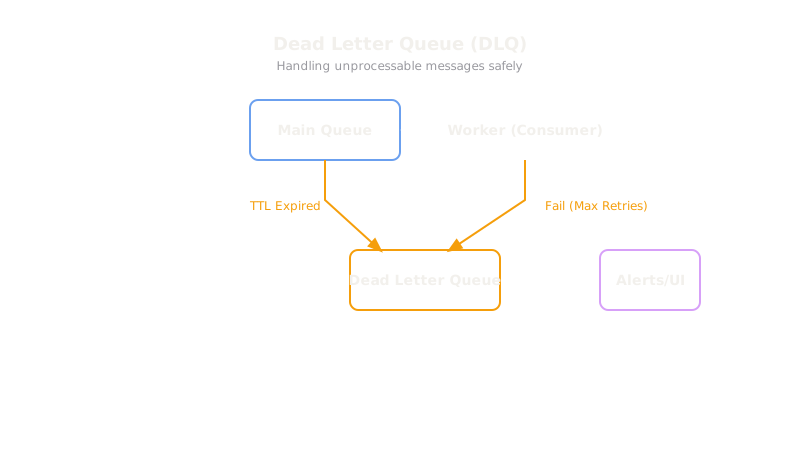
- TTL Expiration: The message lived in the queue longer than its Time-To-Live without being processed.
The DLQ Workflow
A consumer pulls a message. If processing fails, it puts the message back on the queue. To prevent infinite loops (which consume CPU and block other messages), the queue tracks a delivery count. Once a message exceeds the maxReceiveCount (e.g., 3 or 5 times), the broker automatically routes it to the DLQ.
| Queue Type | Purpose | Action Required |
|---|---|---|
| Primary Queue | Normal asynchronous processing. | Automated consumption. |
| Retry Queue (Optional) | Holds messages for delayed backoff retries. | Automated delayed consumption. |
| Dead Letter Queue (DLQ) | Isolates permanently failed messages. | Alerting, manual review, code fix, then redrive. |
Redriving
Once the root cause of the failure is fixed (e.g., a bug in the consumer code is patched), the messages in the DLQ can be redriven - meaning they are moved back to the primary queue to be processed again. Therefore, the DLQ must preserve the exact original message.
Trade-offs
DLQs are essential for system observability and data integrity, preventing silent data loss. The trade-off is operational overhead: a DLQ without monitoring is just a graveyard where data goes to die silently. You must set up alerts on DLQ depth and build tooling to inspect and redrive messages, which adds to the infrastructure burden.
Interview Tips
- Whenever you introduce a message queue in a design, immediately draw or mention a DLQ next to it to show you understand failure modes.
- Use the term "Poison Pill" to describe a message that consistently crashes the consumer.
- Specify that retries should have an exponential backoff before the message is finally sent to the DLQ.
- Mention that DLQs require an alerting mechanism (e.g., page an engineer if DLQ depth > 0).
Summary
- A DLQ catches messages that repeatedly fail to process, preventing infinite retry loops.
- It isolates 'poison pill' messages so they don't block the rest of the queue.
- Failures are typically determined by a max receive count threshold.
- DLQs require monitoring and alerting so engineers know when data is failing.
- Once the underlying bug is fixed, messages in the DLQ can be redriven back to the main queue.