Event-Driven Architecture
On this page
Overview
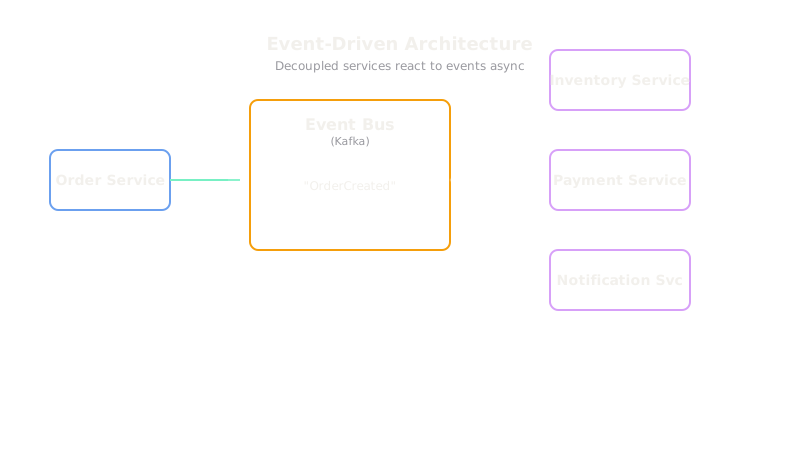
Event-driven architecture is a style in which services communicate by producing and reacting to events - immutable facts about something that happened - instead of calling each other directly. Producers emit events to a broker and interested consumers react asynchronously, so the sender never waits on, or even knows, its recipients.
Key Concepts
In event-driven architecture a producer emits an event to an event broker, and one or more consumers subscribe and react on their own schedule. The broker is typically built on message queues and publish-subscribe messaging, which is what decouples producers from consumers in both time and identity. Common flavors include simple event notification, event-carried state transfer (the event includes the data consumers need), and event sourcing (the ordered log of events is the source of truth).
Benefits
- Loose coupling: producers do not know who consumes their events, so services evolve and deploy independently.
- Independent scalability: consumers scale separately, and the broker buffers spikes so bursts do not overwhelm downstream services.
- Extensibility: adding a new consumer needs no change to the producer.
Challenges
- Eventual consistency: because reactions are asynchronous, the system is only consistent after events propagate, which complicates read-after-write expectations.
- Debugging and tracing: a single request's effects span many services with no shared call stack, so you need correlation IDs and distributed tracing.
- Delivery semantics: consumers must tolerate duplicate and out-of-order events, usually by being idempotent.
Trade-offs
| Aspect | Synchronous request-response | Event-driven |
|---|---|---|
| Coupling | Caller knows and waits on the callee | Producer is unaware of consumers |
| Latency for the caller | Blocks until the work is done | Returns immediately; work happens later |
| Failure handling | Caller sees the failure directly | Broker buffers and retries |
| Consistency | Immediate | Eventual |
| Debugging | Single call stack | Distributed; needs tracing |
Reach for event-driven architecture when workflows are asynchronous by nature (notifications, analytics, order fulfillment), when you must absorb traffic spikes, or when many services react to the same fact. Prefer synchronous calls when the caller genuinely needs an immediate answer, such as a read that must reflect the latest write.
Interview Tips
- Introduce an event backbone when you spot fan-out - one action that triggers several independent reactions - or a need to smooth spikes.
- Say the words "eventual consistency" and explain how you keep consumers idempotent to survive duplicate delivery.
- Do not make everything asynchronous; call out the read paths that still need a synchronous, strongly consistent answer.
Summary
- Event-driven architecture has services communicate through immutable events via a broker instead of direct calls.
- Benefits include loose coupling, independent scaling, spike buffering, and easy extensibility.
- Challenges include eventual consistency, harder debugging, and handling duplicate or out-of-order events.
- It builds on message queues and publish-subscribe messaging to decouple producers from consumers.
- Use it for asynchronous, fan-out workflows and keep synchronous calls where an immediate answer is required.