Data Lakes vs Data Warehouses
On this page
Overview
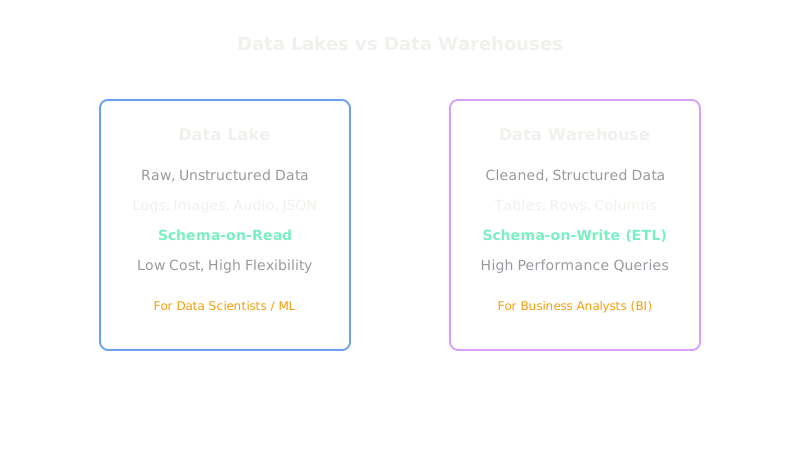
Data Lakes and Data Warehouses are central repositories for an organization's analytical data, but they differ fundamentally in how data is structured, stored, and queried. A warehouse is highly structured and optimized for business reporting; a lake is unstructured and optimized for raw scale and data science exploration.
Key Concepts
Data Warehouse
Stores data that has been cleaned, filtered, and transformed into a strict relational schema (Schema-on-Write). It is used for Business Intelligence (BI), reporting, and SQL analytics. Examples: Snowflake, Amazon Redshift, Google BigQuery.
Data Lake
Stores vast amounts of raw data in its native format (JSON, CSV, Parquet, images, logs). The schema is applied only when the data is read (Schema-on-Read). It is used for machine learning, predictive analytics, and data discovery. Examples: Amazon S3 + Athena, Hadoop (HDFS).
| Aspect | Data Warehouse | Data Lake |
|---|---|---|
| Data Type | Structured (Relational tables) | Unstructured, Semi-structured, Raw |
| Schema | Schema-on-Write (designed upfront) | Schema-on-Read (applied during query) |
| Primary Users | Business Analysts, Data Analysts | Data Scientists, Data Engineers |
| Cost | High (Compute + Storage are often coupled) | Low (Cheap Object Storage) |
| Processing | ETL (Extract, Transform, Load) | ELT (Extract, Load, Transform) |
Trade-offs
Warehouses provide fast, complex SQL querying and guarantee data quality, but they are expensive and rigid. Adding a new data source requires significant engineering (ETL). Lakes are cheap and accept any data instantly, but they can quickly turn into a "Data Swamp" if not governed, where data is untrusted, undocumented, and impossible to query effectively. Modern architectures (Data Lakehouse) attempt to merge the two by putting a warehouse-like query engine directly on top of data lake storage.
Interview Tips
- If the prompt asks about training Machine Learning models on massive logs, draw a Data Lake.
- If the prompt asks about generating fast daily financial reports for executives, draw a Data Warehouse.
- Mention the ELT vs. ETL distinction: Lakes just load the raw data and transform it later (ELT); Warehouses require transformation before loading (ETL).
Summary
- Data Warehouses store highly structured data optimized for business reporting and SQL.
- Data Lakes store raw, unstructured data optimized for machine learning and massive scale.
- Warehouses use Schema-on-Write (ETL); Lakes use Schema-on-Read (ELT).
- Warehouses are expensive and rigid; Lakes are cheap and flexible but risk becoming 'swamps'.
- The Data Lakehouse pattern attempts to combine the best features of both.