Anomaly Detection
How we find the rare exception in a sea of normal data.
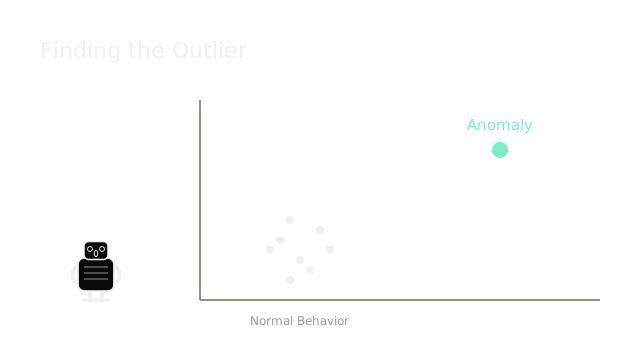
When most of your data follows a predictable pattern, the most valuable information is often the one point that breaks the rule. We need algorithms that can sift through millions of normal events to flag the rare outlier.
Density Approach
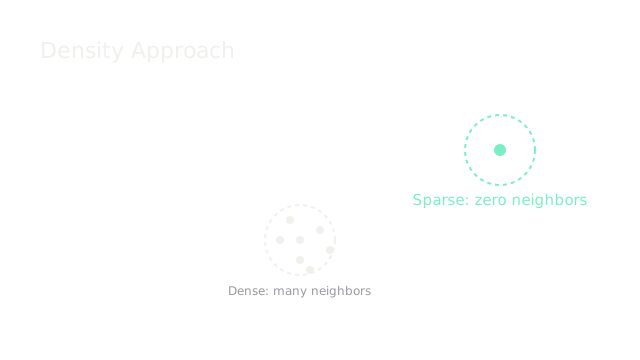
One way to find an anomaly is to look at local density. Normal points are surrounded by many neighbors. An anomaly sits in a sparse region of the space, isolated from the rest of the crowd.
Isolation Approach
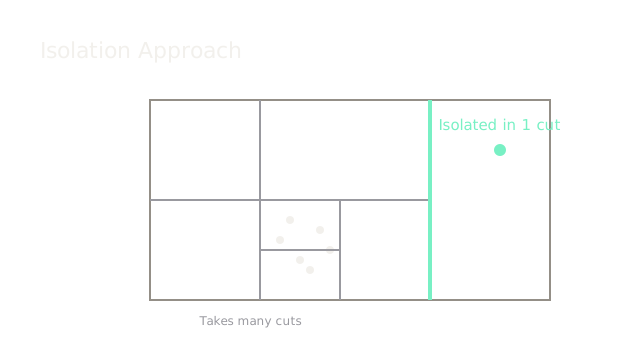
Instead of calculating distances, Isolation Forests draw random lines through the space. Because an anomaly is far from the rest of the data, it gets walled off by itself in just one or two cuts. Dense clusters require many cuts to separate.
What It Buys You
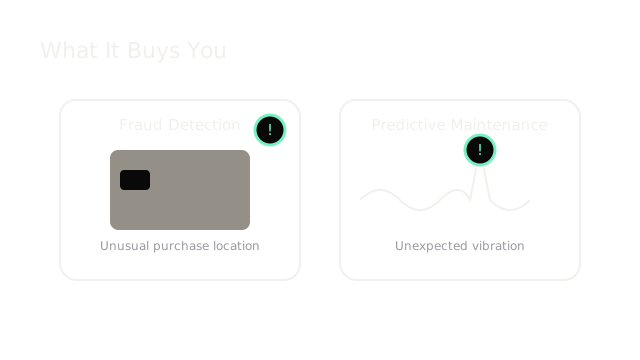
These mathematical flags map directly to real-world problems. A point far from its cluster is an unexpected credit card swipe, a server intrusion, or a machine vibrating in a way it never has before.
Where It Breaks
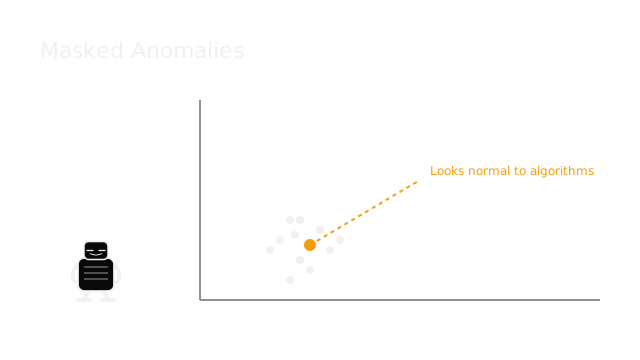
If an anomaly is perfectly masked—such as a stolen password being used from a recognized device at a normal time—it falls right into the center of the normal cluster. Structural algorithms cannot find what they cannot see.
The Quick Version
- The goal: Find the rare outlier in a sea of normal data.
- Density: Anomalies lack close neighbors.
- Isolation: Anomalies get cut off by random partitions quickly.
- The payoff: Automatic alerts for fraud and failure.
- The limit: Masked anomalies inside the cluster are invisible.