Visual explainer
Attention Mechanism
Follow a query from key scores through normalized weights to a value blend, then inspect how a new query and score scaling change it.
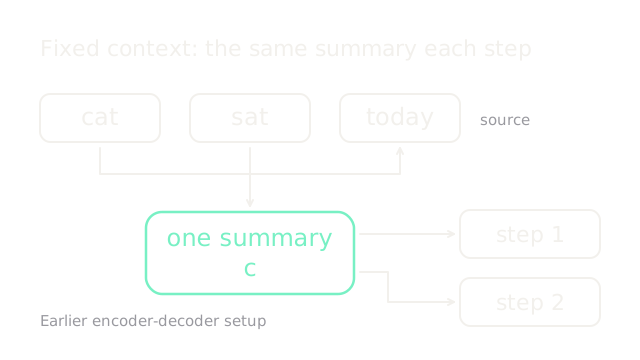
Attention builds a query-specific blend of stored values. Earlier encoder-decoder models reused one fixed context; attention instead keeps source positions available for each query. Compressing a whole sentence into one summary can make long inputs harder, but no vector literally overflows.
Score Every Word
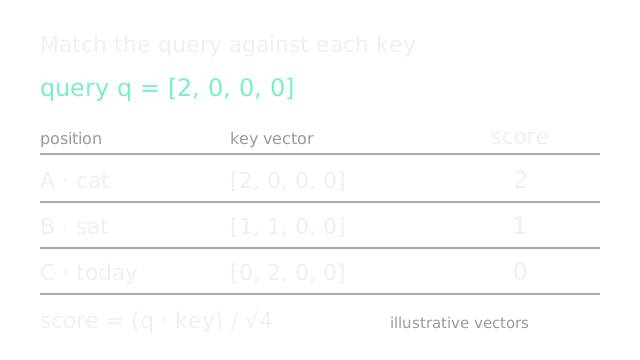
A query asks what to match; keys determine matching scores; values supply the material to blend. These illustrative vectors aren't learned word meanings. With four key coordinates, query [2,0,0,0] gives dots [4,2,0]; dividing by √4 gives scores [2,1,0].
Blend by Weight
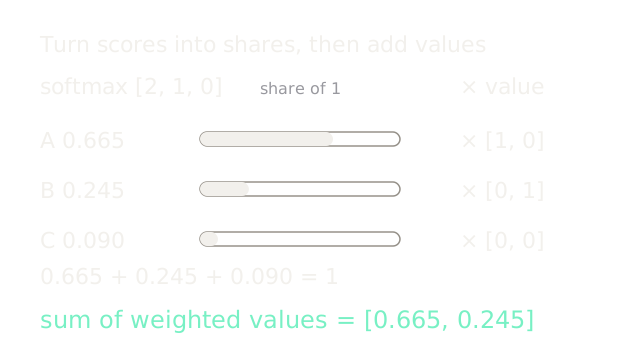
Exponentiate the scores to [7.389,2.718,1], then divide by their sum, about 11.107. Weights round to [0.665,0.245,0.090]. Multiplying values [1,0], [0,1], [0,0] and adding gives output [0.665,0.245]. That output is a vector, distinct from the three weights.
Refocus Each Step
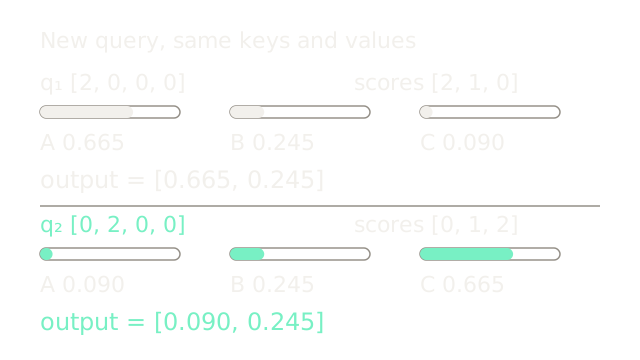
Keep the keys and values. Query [0,2,0,0] gives scores [0,1,2] and weights [0.090,0.245,0.665]. The output becomes [0.090,0.245], because the third value is [0,0]. Recompute weights for a new query; stored keys and values can still be reused.
Keep Source Positions Available
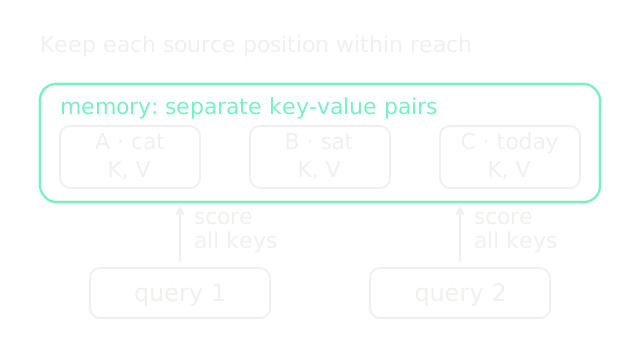
The decoder can address individual encoder positions rather than depend entirely on one shared summary. This cross-attention example uses decoder queries and encoder keys/values. In self-attention, all three originate from the same sequence. Access doesn't guarantee useful matching or perfect recall; scoring more positions costs more work.
Shrink the Scores
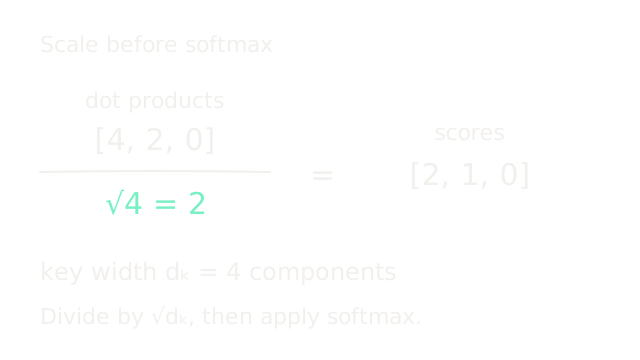
Our four-coordinate keys use divisor 2. With 64 coordinates, the divisor would be 8. Under independent, zero-mean, unit-variance query/key components, scaling counters dot-product variance growth. It doesn't guarantee broad weights; large score differences can remain.
Where It Breaks
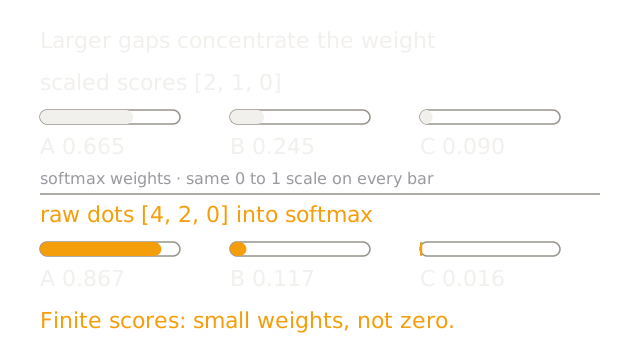
Without scaling, our dots [4,2,0] produce weights about [0.867,0.117,0.016]. Every weight remains positive. Much larger gaps can make local softmax derivatives tiny; finite scores don't imply exact one-hot weights or zero gradients throughout the model. Sharp attention also needn't identify the right source.
The Quick Version
- Fixed-context decoders reuse one summary across output steps.
- Queries score keys; values supply the blend's contents.
- Softmax weights sum to one before multiplying value vectors.
- New queries change weights while keys and values can remain.
- Access to source positions doesn't guarantee perfect recall.
- Scale dot products by the square root of key width.
- Large score gaps can concentrate weights and reduce softmax sensitivity.